Moz Q&A is closed.
After more than 13 years, and tens of thousands of questions, Moz Q&A closed on 12th December 2024. Whilst we’re not completely removing the content - many posts will still be possible to view - we have locked both new posts and new replies. More details here.
What's the SEO impact of url suffixes?
-
Is there an advantage/disadvantage to adding an .html suffix to urls in a CMS like WordPress. Plugins exist to do it, but it seems better for the user to leave it off. What do search engines prefer?
-
After I finished work, I will dig through my history and can hopefully deliver.
Update: I spent 1 hour going through my browser history and I was not able to find it. Kinda freaks me out. Sorry.
-
I would love to see the study if you can find the link later. I agree sometimes study results conflict with prior conceptions and I have been mistaken before, but those study results really sound counter intuitive.
-
There are actually some studies that can be found on the internet that suggest that the CTR correlates with the extension shown on the SERP, namely .html is supposedly having a positive impact on the CTR of up to 200%.
I was trying hard to find the website I read it on, but on the quick I couldn't find it. It contained a "study" on it with eyetracking and it made sense.
I've personally never run a test on it, but I decided to add html to our documents by means of Mod Rewrite.
As far as search engines are concerned, it does not matter at all. But overall, the visitor should be more important and seeing that it does not negatively impact rankings, it's worth a try.
-
When possible, always remove the .html or any technology suffix such as .php, .htm, etc. A few reasons:
-
this information offers no value to users nor search engines
-
it needlessly increases the length of your URL
-
it offers hackers an additional piece of information about your web server files. You want to make the bad guys work as hard as possible
-
it helps a lot with SEO when you change technologies. There is good reason for .html pages to move to .php pages. When that change is made, all the pages on a site need to be 301'd. The entire process is a big waste of link juice for the entire site which could be avoided if the technology extension did not exist. While .html and .php pages are common today, next year .seo pages might be the popular extension.
-



Got a burning SEO question?
Subscribe to Moz Pro to gain full access to Q&A, answer questions, and ask your own.
Browse Questions
Explore more categories
-
Moz Tools
Chat with the community about the Moz tools.
-
SEO Tactics
Discuss the SEO process with fellow marketers
-
Community
Discuss industry events, jobs, and news!
-
Digital Marketing
Chat about tactics outside of SEO
-
Research & Trends
Dive into research and trends in the search industry.
-
Support
Connect on product support and feature requests.
Related Questions
-

SEO advice on ecommerce url structure where categories contain "/c/"
Hi! We use Hybris as plattform and I would like input on which url to choose. We must keep "/c/" before the actual category. c stands for category. I.e. this current url format will be shortened and cleaned:
Technical SEO | | hampgunn
https://www.granngarden.se/Sortiment/Husdjur/Hund/Hundfoder-%26-Hundmat/c/hundfoder To either: a.
https://www.granngarden.se/husdjur/hund/hundfoder/c/hundfoder b.
https://www.granngarden.se/husdjur/hund/c/hundfoder (hundfoder means dogfood) The question is whether we should keep the duplicated category name (hundfoder) before the "/c/" or not. Will there be SEO disadvantages by removing the duplicate "hundfoder" before the "/c/"? I prefer the shorter version ofc, but do not want to jeopardize any SEO rankings or send confusing signals to search engines or customers due to the "/c/" breaking up the url breadcrumb. What do you guys say and prefer from the above alternatives? Thanks /Hampus0 -

Problem with Yoast not seeing any of this website's text/content
Hi, My client has a new WordPress site http://www.londonavsolutions.co.uk/ and they have installed the Yoast Premium SEO plug-in. They are having issues with getting the lights to go green and the main problem is that on most pages Yoast does not see any words/content – although there are plenty of words on the pages. Other tools can see the words, however Yoast is struggling to find any and gives the following message:- Bad SEO score. The text contains 0 words. This is far below the recommended minimum of 300 words. Add more content that is relevant for the topic. Readability - You have far too little content. Please add some content to enable a good analysis. They have contacted the website developer who says that there is nothing wrong, but they are frustrated that they cannot use the Yoast tools themselves because of this issue, plus Yoast are offering no support with the issue. I hope that one of you guys has seen this problem before, or can spot a problem with the way the site has been built and can perhaps shed some light on the problem. I didn't build the site myself so won't be offended if you spot problems with it. Thanks in advance, Ben
Technical SEO | | bendyman0 -

My Homepage Won't Load if Javascript is Disabled. Is this an SEO/Indexation issue?
Hi everyone, I'm working with a client who recently had their site redesigned. I'm just going through to do an initial audit to make sure everything looks good. Part of my initial indexation audit goes through questions about how the site functions when you disable, javascript, cookies, and/or css. I use the Web Developer extension for Chrome to do this. I know, more recently, people have said that content loaded by Javascript will be indexed. I just want to make sure it's not hurting my clients SEO. http://americasinstantsigns.com/ Is it as simple as looking at Google's Cached URL? The URL is definitely being indexed and when looking at the text-only version everything appears to be in order. This may be an outdated question, but I just want to be sure! Thank you so much!
Technical SEO | | ccox10 -

Loading images below the fold? Impact on SEO
I got this from my developers. Does anyone know if this will be a SEO issue? We hope to lazy-load images below the fold where possible, to increase render speed - are you aware of any potential issues with this approach from an SEO point of view?
Technical SEO | | KatherineWatierOng1 -

Will removing the trailing slash impact my SEO?
Hi there, We have a company website based on Wordpress. I just noticed that under Settings > Permalinks I can configure the look of the URLs and even remove the trailing slash. We have about 2-300 pages online. If I remove the trailing slash now, will that negatively impact our SEO in anyway for existing pages? Thanks!
Technical SEO | | Amr-Haffar0 -

Does Title Tag location in a page's source code matter?
Currently our meta description is on line 8 for our page - http://www.paintball-online.com/Paintball-Guns-And-Markers-0Y.aspx
Technical SEO | | Istoresinc The title tag, however sits below a bunch of code on line 237
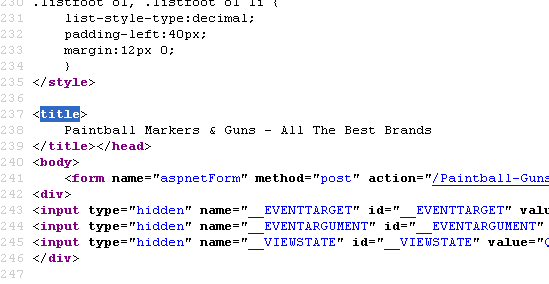 Does the location of the title tag, meta tags, and any structured data have any influence with respect to SEO and search engines? Put another way, could we benefit from moving the title tag up to the top?
I "surfed 'n surfed" and could not find any articles about this.
I would really appreciate any help on this as our site got decimated organically last May and we are looking for any help with SEO.
NIck
0
Does the location of the title tag, meta tags, and any structured data have any influence with respect to SEO and search engines? Put another way, could we benefit from moving the title tag up to the top?
I "surfed 'n surfed" and could not find any articles about this.
I would really appreciate any help on this as our site got decimated organically last May and we are looking for any help with SEO.
NIck
0 -

How to Remove /feed URLs from Google's Index
Hey everyone, I have an issue with RSS /feed URLs being indexed by Google for some of our Wordpress sites. Have a look at this Google query, and click to show omitted search results. You'll see we have 500+ /feed URLs indexed by Google, for our many category pages/etc. Here is one of the example URLs: http://www.howdesign.com/design-creativity/fonts-typography/letterforms/attachment/gilhelveticatrade/feed/. Based on this content/code of the XML page, it looks like Wordpress is generating these: <generator>http://wordpress.org/?v=3.5.2</generator> Any idea how to get them out of Google's index without 301 redirecting them? We need the Wordpress-generated RSS feeds to work for various uses. My first two thoughts are trying to work with our Development team to see if we can get a "noindex" meta robots tag on the pages, by they are dynamically-generated pages...so I'm not sure if that will be possible. Or, perhaps we can add a "feed" paramater to GWT "URL Parameters" section...but I don't want to limit Google from crawling these again...I figure I need Google to crawl them and see some code that says to get the pages out of their index...and THEN not crawl the pages anymore. I don't think the "Remove URL" feature in GWT will work, since that tool only removes URLs from the search results, not the actual Google index. FWIW, this site is using the Yoast plugin. We set every page type to "noindex" except for the homepage, Posts, Pages and Categories. We have other sites on Yoast that do not have any /feed URLs indexed by Google at all. Side note, the /robots.txt file was previously blocking crawling of the /feed URLs on this site, which is why you'll see that note in the Google SERPs when you click on the query link given in the first paragraph.
Technical SEO | | M_D_Golden_Peak0 -

What's the difference between a category page and a content page
Hello, Little confused on this matter. From a website architectural and content stand point, what is the difference between a category page and a content page? So lets say I was going to build a website around tea. My home page would be about tea. My category pages would be: White Tea, Black Tea, Oolong Team and British Tea correct? ( I Would write content for each of these topics on their respective category pages correct?) Then suppose I wrote articles on organic white tea, white tea recipes, how to brew white team etc...( Are these content pages?) Do I think link FROM my category page ( White Tea) to my ( Content pages ie; Organic White Tea, white tea receipes etc) or do I link from my content page to my category page? I hope this makes sense. Thanks, Bill
Technical SEO | | wparlaman0