Moz Q&A is closed.
After more than 13 years, and tens of thousands of questions, Moz Q&A closed on 12th December 2024. Whilst we’re not completely removing the content - many posts will still be possible to view - we have locked both new posts and new replies. More details here.
What happens when you put an image in an H1 tag?
-
I am currently updating some H1 tags for my site but the tags are generated automatically by the text that is entered into a field on our content manager software. However because we need an image in this area as well, the entire field including the code for the image is surrounded by an H1 tag.
Is this bad for SEO?
-
Thank you Dan (and Bill).
In SEO talk, everything seems to boil down to getting ranked, but the more important thing, I've always thought, is helping readers (and the search engines) to understand what the page is about - but almost nobody talks about that.
-
In general its bad practice to put images in the H1. This doesn't mean if you just stuff a few keywords in them that you'll rank better either. But the Header tags are meant to hold text - text that accurately describes to the reader what they should expect to see below the header.
Bill's article on headers is fantastic.
And the original source from w3.org says:
"A heading element briefly describes the topic of the section it introduces...." - basically that it's meant for text. Source
So as Bill says, if you correctly set up a semantic relationship between the title, headers and content on the page, you can help users and engines understand what the page is "about" and thus rank better in that sense.
Hope that helps!!
-Dan



Got a burning SEO question?
Subscribe to Moz Pro to gain full access to Q&A, answer questions, and ask your own.
Browse Questions
Explore more categories
-
Moz Tools
Chat with the community about the Moz tools.
-
SEO Tactics
Discuss the SEO process with fellow marketers
-
Community
Discuss industry events, jobs, and news!
-
Digital Marketing
Chat about tactics outside of SEO
-
Research & Trends
Dive into research and trends in the search industry.
-
Support
Connect on product support and feature requests.
Related Questions
-

Does google look at H3 tags?
I've had someone tell me that google doesn't pay attention to H3 tags -- only H1 and H2. I haven't found much online to back this up or discredit it; thought I'd ask the Moz community!
Technical SEO | | LivDetrick5 -

Duplicate title while setting canonical tag.
Hi Moz Fan, My websites - https://finance.rabbit.co.th/ has run financial service, So our main keywords is about "Insurance" in Thai, But today I have an issues regarding to carnonical tag. We have a link that containing by https://finance.rabbit.co.th/car-insurance?showForm=1&brand_id=9&model_id=18&car_submodel_id=30&ci_source_id=rabbit.co.th&car_year=2014 and setting canonical to this url - https://finance.rabbit.co.th/car-insurance within 5,000 items. But in this case I have an warning by site audit tools as Duplicate Page Title (Canonical), So is that possible to drop our ranking. What should we do, setting No-Index, No-Follow for all URL that begin with ? or keep them like that.
Technical SEO | | ASKHANUMANTHAILAND0 -

Title Tag vs. H1 / H2
OK, Title tag, no problem, it's the SEO juice, appears on SERP, etc. Got it. But I'm reading up on H1 and getting conflicting bits of information ... Only use H1 once? H1 is crucial for SERP Use H1s for subheads Google almost never looks past H2 for relevance So say I've got a blog post with three sections ... do I use H1 three times (or does Google think you're playing them ...) Or do I create a "big" H1 subhead and then use H2s? Or just use all H2s because H1s are scary? 🙂 I frequently use subheads, it would seem weird to me to have one a font size bigger than another, but of course I can adjust that in settings ... Thoughts? Lisa
Technical SEO | | ChristianRubio0 -
Image Indexing Issue by Google
Hello All,My URL is: www.thesalebox.comI have Submitted my image Sitemap in google webmaster tool on 10th Oct 2013,Still google could not indexing any of my web images,Please refer my sitemap - www.thesalebox.com/AppliancesHomeEntertainment.xml and www.thesalebox.com/Hardware.xmland my webmaster status and image indexing status are below,
Technical SEO | | CommercePundit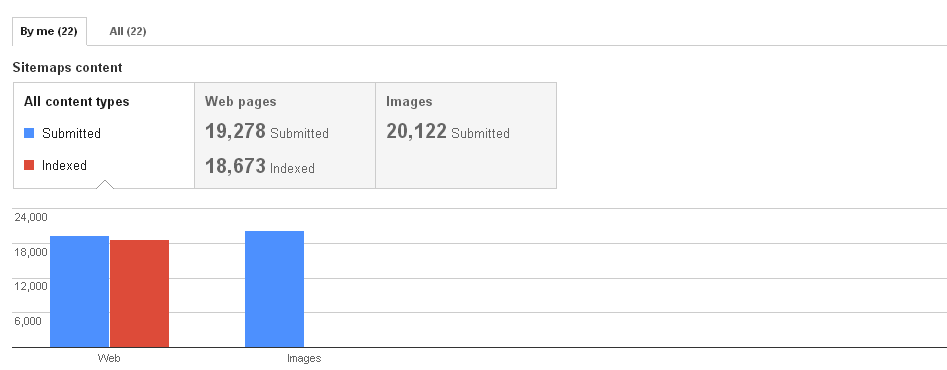 Can you please help me, why my images are not indexing in google yet? is there any issue? please give me suggestions?Thanks!
0
Can you please help me, why my images are not indexing in google yet? is there any issue? please give me suggestions?Thanks!
0 -

Div tags vs. Tables
Is there any reason NOT to code in tables (other than it being outdated) for SEO reasons?
Technical SEO | | EileenCleary0 -

Should H1 tags include location?
I have an IT services company that is based out of Denver. In the past I always used Denver in the H1 tag like this "Denver IT Support & Managed Services" or "Denver Data Center Solutions" I know that H tags are not that important any more but I still want to put them on each page. My question is in a post panda world do those look too spammy? Should I not include Denver on each page. I have about 25 service pages that I was going to do this for. Each page will be different because of the service but I was going to include Denver on each page. On that same note how, I normally put never in the title for each page. Should I rethink this also? Obvisouly I want to rank on Denver and the service. Any help on this would be great. Thanks
Technical SEO | | ZiaTG0 -

Use of Meta Tag - MSSmartTagsPreventParsing
We've inherited some sites from another developer that had the following tag: All references I can find to it are from 2004. What is the purpose and is it worth including in pages/sites we build?
Technical SEO | | wcksmith0 -

Meta tag "noindex,nofollow" by accident
Hi, 3 weeks ago I wanted to release a new website (made in WordPress), so I neatly created 301 redirects for all files and folders of my old html website and transferred the WordPress site into the index folder. Job well done I thought, but after a few days, my site suddenly disappeared from google. I read in other Q&A's that this could happen so I waited a little longer till I finally saw today that there was a meta robots added on every page with "noindex, nofollow". For some reason, the WordPress setting "I want to forbid search engines, but allow normal visitors to my website" was selected, although I never even opened that section called "Privacy". So my question is, will this have a negative impact on my pagerank afterwards? Thanks, Sven
Technical SEO | | Zitana0
