Moz Q&A is closed.
After more than 13 years, and tens of thousands of questions, Moz Q&A closed on 12th December 2024. Whilst we’re not completely removing the content - many posts will still be possible to view - we have locked both new posts and new replies. More details here.
MBG Tracker...how to use it?
-
So I am a new blogger that has been submitting guest blog posts to a number of different blogs. It was recommended that I use the MBG Tracker so I can track the back links. The problem is that I am totally lost on how to use this tool. As I said before I am new to this whole thing and I am not really sure what constitutes a "base link" and a "back link." In the author bylines we are linking to different pages within a larger website. If anyone can help me I would really appreciate it!
-
Thanks for the reply Ann! David, SEOmoz and MyBlogGuest are different products, you'll probably find the best help for MBG talking with Ann or using her support forums.
-
Let me try to be very clear. Please email if you have more questions (I got both of your emails, so feel free to use the email)
When guest blogging, are you promoting ONE site in your byline in each of the guest posts? There can be different pages from one site, but one and the same domain.
For example:
- Project name: SEOmoz
- Base domain: seomoz.org
Then when you decide to upload this page, for example: http://www.geekwire.com/2012/seomoz-secret-startup-success-rand-fishkins-tips/ - the tracker will automatically identify the backlink to track - http://www.seomoz.org/dp/seattle-startup-marketing - because it has seomoz.org base domain.
By providing the base domain, you make your own job easier because you don't have to manually provide the tool with the backlink to track!
-
So the base link would be the link to the blog post and the back link is the link that goes back to my site? Is this correct? I had seen the site that you suggested but like I said I was confused by the base link and the back link.
-
Base link is a normal submission with a link. Back link has more value with guest blogging.
HOW DOES THE BACKLINK MONITORING TOOL WORK?
This is the cheapest and simplest alternative I am aware of:
- Receive instant emails if any of your links were removed or nofollowed;
- Track your guest post social popularity (Likes and Tweets)
- Measure traffic from each of your guest posts (for that you’ll need to install a tracking code)
- Identify most efficient backlink sources (for example, to find places where you canguest post again).
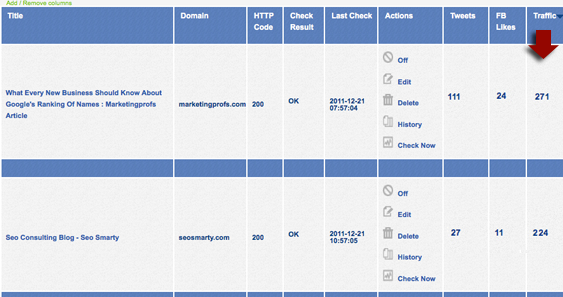
To start tracking your guest posts or links, you’ll need to create a new project and specify your base URL. For all pages you add within one project, this very base URL will be monitored automatically (even if you don’t specify which link within a given page you want to track).
You can add / remove columns from the table (to adjust a clearer view) and sort by each column. You will also receive weekly summaries of your missing links and most popular link sources.
Handy url for more info..... http://www.seosmarty.com/meet-mbg-tracker-the-simplest-and-cheapest-way-to-monitor-your-backlinks/




Got a burning SEO question?
Subscribe to Moz Pro to gain full access to Q&A, answer questions, and ask your own.
Browse Questions
Explore more categories
-
Moz Tools
Chat with the community about the Moz tools.
-
SEO Tactics
Discuss the SEO process with fellow marketers
-
Community
Discuss industry events, jobs, and news!
-
Digital Marketing
Chat about tactics outside of SEO
-
Research & Trends
Dive into research and trends in the search industry.
-
Support
Connect on product support and feature requests.
Related Questions
-

Good to use disallow or noindex for these?
Hello everyone, I am reaching out to seek your expert advice on a few technical SEO aspects related to my website. I highly value your expertise in this field and would greatly appreciate your insights.
Technical SEO | | williamhuynh
Below are the specific areas I would like to discuss: a. Double and Triple filter pages: I have identified certain URLs on my website that have a canonical tag pointing to the main /quick-ship page. These URLs are as follows: https://www.interiorsecrets.com.au/collections/lounge-chairs/quick-ship+black
https://www.interiorsecrets.com.au/collections/lounge-chairs/quick-ship+black+fabric Considering the need to optimize my crawl budget, I would like to seek your advice on whether it would be advisable to disallow or noindex these pages. My understanding is that by disallowing or noindexing these URLs, search engines can avoid wasting resources on crawling and indexing duplicate or filtered content. I would greatly appreciate your guidance on this matter. b. Page URLs with parameters: I have noticed that some of my page URLs include parameters such as ?variant and ?limit. Although these URLs already have canonical tags in place, I would like to understand whether it is still recommended to disallow or noindex them to further conserve crawl budget. My understanding is that by doing so, search engines can prevent the unnecessary expenditure of resources on indexing redundant variations of the same content. I would be grateful for your expert opinion on this matter. Additionally, I would be delighted if you could provide any suggestions regarding internal linking strategies tailored to my website's structure and content. Any insights or recommendations you can offer would be highly valuable to me. Thank you in advance for your time and expertise in addressing these concerns. I genuinely appreciate your assistance. If you require any further information or clarification, please let me know. I look forward to hearing from you. Cheers!0 -

Does using a canonical with ?utm_source=gmb cause any issues?
All of our URLs in Google My Business are tagged with ?utm_source=gmb. This way when people click on it within a Google Map listing, knowledge graph, etc we know it came from there. I'm assuming using a canonical on all ?_utm_source _pages (we have others, including some in the index) won't cause any problems with this, correct? Since they're not technically traditional organic SERPs? Dumb question I know, but better safe than sorry. Thanks.
Technical SEO | | Alces1 -

Canonical homepage link uses trailing slash while default homepage uses no trailing slash, will this be an issue?
Hello, 1st off, let me explain my client in this case uses BigCommerce, and I don't have access to the backend like most other situations. So I have to rely on BG to handle certain issues. I'm curious if there is much of a difference using domain.com/ as the canonical url while BG currently is redirecting our domain to domain.com. I've been using domain.com/ consistently for the last 6 months, and since we switches stores on Friday, this issue has popped up and has me a bit worried that we'll loose somehow via link juice or overall indexing since this could confuse crawlers. Now some say that the domain url is fine using / or not, as per - https://azwa.1clkaccess.in/community/q/trailing-slash-and-rel-canonical But I also wanted to see what you all felt about this. What says you?
Technical SEO | | Deacyde0 -
Genesis WP Theme H1 Tag not properly Used?
I am in the process of redesigning my website, and I have been working on the Genesis framework a lot lately, so I used the Genesis framework to make my new site. The URL is http://protechig.com As I look at the H1 on the page (homepage only, every other page has solid h1s from an SEO perspective.) The first thing that I see is that the home page H1 is a links (to protech's home page). The second thing that I see is the the title text is replaced with an image (my logo) and there is a text-indent:-99999; and overflow:hiden; I just want to know from an SEO perspective if this is okay, and, if it isn't, what I could/should to to rectify it. Thanks Zach
Technical SEO | | Zachary_Russell0 -

Use webmaster tools "change of address" when doing rel=canonical
We are doing a "soft migration" of a website. (Actually it is a merger of two websites). We are doing cross site rel=canonical tags instead of 301's for the first 60-90 days. These have been done on a page by page basis for an entire site. Google states that a "change of address" should be done in webmaster tools for a site migration with 301's. Should this also be done when we are doing this soft move?
Technical SEO | | EugeneF0 -

Should we use "and" or "&"?
Our client has an ampersand in their brand name. The logo has "&", their url is spelled out. I'm trying to get them to standardize the use of the name for directories/listings. Should we use "and" or "&"?
Technical SEO | | vernonmack0 -

Using symbols in the html title of a webpage
If you a symbol in the title of a webpage will this dilute the keywords in the title
Technical SEO | | mickey11
thus making it rank worse in search engines here is an example <title><br /> Black Shoe Polish<br /></title> versus <title><br /> ▶ Black Shoe Polish<br /></title> will the extra symbols count as words and thus the dilute the effectiveness of the Black Shoe Polish keyword. sort of making like 4 words instead 3. By the way, The reason to use a symbol is to make it stand on in the search engine results0 -

Use of + in url good or bad?
Hi, I am working on a SEO project for a client.
Technical SEO | | MaartenvandenBos
Some of the urls have a + between the keyword.
like www.example.com/make+me+happy/ Is this good or bad for seo?
Or is it maybe better to use - ? Thanks!0
