Moz Q&A is closed.
After more than 13 years, and tens of thousands of questions, Moz Q&A closed on 12th December 2024. Whilst we’re not completely removing the content - many posts will still be possible to view - we have locked both new posts and new replies. More details here.
Image search and CDNs
-
Hi,
Our site has a very high domain strength. Although our site ranks well for general search phrases, we rank poorly for image search (even though our site has very high quality images). Our images are hosted on a separate CDN with a different domain. Although there are a number of benefits to doing this, since they are on a different domain, are we not able to capitalize on our my site's domain strength? Is there any way to associate our CDN to our main site via Google webmaster tools? Has anyone researched the search ranking impacts due to storing your images on a CDN, given that your domain strength is very high?
Curious on people's thoughts?
-
Hi NicB1,
We use Amazon CloudFront here at SEOmoz and it allows us to setup a CNAME for our CDN. So if you look at our images you will see we use a few different ones, such as cdn.seomoz.org, profile1.seomoz.org and profile2.seomoz.org. While I haven't done any studies on this, I can tell you that we have not seen a major change in image traffic in making the CDN switch a few months ago.
I'd check with your CDN people and see if you can setup a CNAME and place it on a subdomain.
Casey
-
I'll leave it to others who might have done serious testing on this to discuss findings. I will say this though - if the CDN is not a domain you own, or can readily show through other optimization efforts that you own it, it's at least partly a matter of "how do we know this site owns these images?". Purely from SEO best practices thinking, when a site hosts their images, there's a much lower threshold of being able to have them recognized for consideration, let alone associated with image names, alt attributes, and page topical focus.



Got a burning SEO question?
Subscribe to Moz Pro to gain full access to Q&A, answer questions, and ask your own.
Browse Questions
Explore more categories
-
Moz Tools
Chat with the community about the Moz tools.
-
SEO Tactics
Discuss the SEO process with fellow marketers
-
Community
Discuss industry events, jobs, and news!
-
Digital Marketing
Chat about tactics outside of SEO
-
Research & Trends
Dive into research and trends in the search industry.
-
Support
Connect on product support and feature requests.
Related Questions
-

Errors In Search Console
Hi All, I am hoping someone might be able to help with this. Last week one of my sites dropped from mid first day to bottom of page 1. We had not been link building as such and it only seems to of affected a single search term and the ranking page (which happens to be the home page). When I was going through everything I went to search console and in crawl errors there are 2 errors that showed up as detected 3 days before the drop. These are: wp-admin/admin-ajax.php showing as response code 400 and also xmlrpc.php showing as response code 405 robots.txt is as follows: user-agent: * disallow: /wp-admin/ allow: /wp-admin/admin-ajax.php Any help with what is wrong here and how to fix it would be greatly appreciated. Many Thanks
Technical SEO | | DaleZon0 -

Is it important to include image files in your sitemap?
I run an ecommerce business that has over 4000 product pages which, as you can imagine, branches off into thousands of image files. Is it necessary to include those in my sitemap for faster indexing? Thanks for you help! -Reed
Technical SEO | | IceIcebaby0 -
Image Indexing Issue by Google
Hello All,My URL is: www.thesalebox.comI have Submitted my image Sitemap in google webmaster tool on 10th Oct 2013,Still google could not indexing any of my web images,Please refer my sitemap - www.thesalebox.com/AppliancesHomeEntertainment.xml and www.thesalebox.com/Hardware.xmland my webmaster status and image indexing status are below,
Technical SEO | | CommercePundit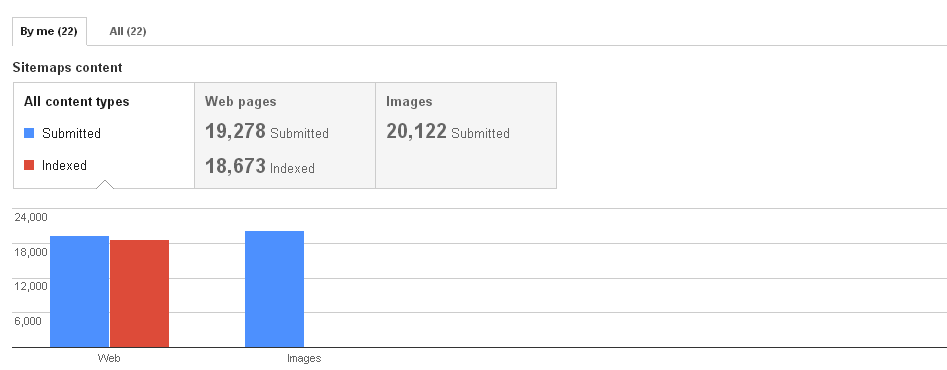 Can you please help me, why my images are not indexing in google yet? is there any issue? please give me suggestions?Thanks!
0
Can you please help me, why my images are not indexing in google yet? is there any issue? please give me suggestions?Thanks!
0 -

Speed benefits from loading images from a subdomain
I have read that loading images from a subdomain of your site instead of the main domain will give you speed benefits on load time. Has anyone actually seen that to be the case? Thanks!
Technical SEO | | Gordian0 -

Does image domain name matter when using a CDN?
Has anyone does studies on using a different CDN domain name for images on a site? Here is an example:
Technical SEO | | findwell or
http://cdn.mydomain.com/image.jpg>
mydomain.com ranks highly and many images show up in Google/Bing image searches. Is there any actual data that says that using your real domain name for the CDN has benefits versus the default domain name provided by the CDN provider? On the surface, it feels like it would, but I haven't experimented with it.
0
or
http://cdn.mydomain.com/image.jpg>
mydomain.com ranks highly and many images show up in Google/Bing image searches. Is there any actual data that says that using your real domain name for the CDN has benefits versus the default domain name provided by the CDN provider? On the surface, it feels like it would, but I haven't experimented with it.
0 -

How does a search engine bot navigate past a .PDF link?
We have a large number of product pages that contain links to a .pdf of the technical specs for that product. These are all set up to open in a new window when the end user clicks. If these pages are being crawled, and a bot follows the link for the .pdf, is there any way for that bot to continue to crawl the site, or does it get stuck on that dangling page because it doesn't contain any links back to the site (it's a .pdf) and the "back" button doesn't work because the page opened in a new window? If this situation effectively stops the bot in its tracks and it can't crawl any further, what's the best way to fix this? 1. Add a rel="nofollow" attribute 2. Don't open the link in a new window so the back button remains finctional 3. Both 1 and 2 or 4. Create specs on the page instead of relying on a .pdf Here's an example page: http://www.ccisolutions.com/StoreFront/product/mackie-cfx12-mkii-compact-mixer - The technical spec .pdf is located under the "Downloads" tab [the content is all on one page in the source code - the tabs are just a design element] Thoughts and suggestions would be greatly appreciated. Dana
Technical SEO | | danatanseo0 -

Internal search : rel=canonical vs noindex vs robots.txt
Hi everyone, I have a website with a lot of internal search results pages indexed. I'm not asking if they should be indexed or not, I know they should not according to Google's guidelines. And they make a bunch of duplicated pages so I want to solve this problem. The thing is, if I noindex them, the site is gonna lose a non-negligible chunk of traffic : nearly 13% according to google analytics !!! I thought of blocking them in robots.txt. This solution would not keep them out of the index. But the pages appearing in GG SERPS would then look empty (no title, no description), thus their CTR would plummet and I would lose a bit of traffic too... The last idea I had was to use a rel=canonical tag pointing to the original search page (that is empty, without results), but it would probably have the same effect as noindexing them, wouldn't it ? (never tried so I'm not sure of this) Of course I did some research on the subject, but each of my finding recommanded one of the 3 methods only ! One even recommanded noindex+robots.txt block which is stupid because the noindex would then be useless... Is there somebody who can tell me which option is the best to keep this traffic ? Thanks a million
Technical SEO | | JohannCR0 -

How do search engines treat urls that end in hashtags?
How do search engines treat urls that end in hashtags? For example, www.domain.com/abc#xyz.
Technical SEO | | nicole.healthline0
