Moz Q&A is closed.
After more than 13 years, and tens of thousands of questions, Moz Q&A closed on 12th December 2024. Whilst we’re not completely removing the content - many posts will still be possible to view - we have locked both new posts and new replies. More details here.
Is it good practice to still pay for Best of the Web Directory (BOTW) and other similar one's you have to pay for?
-
I know that paid for links are hit by Google, but in the past these directories were okay. What about now?
Thank you.
-
"If you pay for a directory link only to gain position in the SERPs you will most probably not get any ROI"
Meaning if you are on the first page there won`t be ROI? I dont think so!
-
There are exceptions to the "paid for" link rule and I believe this site is one of them as they qualify there links! However whether you'll get ROI from it is another question!
-
Hi,
Well in general I agree with Arjan, I am strongly of the opinion that some directories are still VERY worthwhile, and BOTW is one of them. When you are launching a brand new site, you just aren't going to have a lot of attention and inbound lin opportunities at first. Submitting your site to DMOZ (which is free), Yahoo.dir (Paid), Business.com (Paid), JoeAnt.com (Paid) and yes, BOTW (Paid) are all most definitely worthwhile. IMHO they send a signal to the search engines that you are a legitimate business. That's a very important message to send when you are a startup.
In addition to those I think there are some others that are worth it as well, depending on your particular business, particularly localized directories and directories targeting certain niche markets.
Hope that's helpful!
Dana
-
My advice will be to only pay for directory links that drive enough traffic to your website directly to get a proper ROI.
If you pay for a directory link only to gain position in the SERPs you will most probably not get any ROI.
If you get the link from a directory Google does not like because it is known to be selling links it could even hurt your rankings.In short: Paid directory links are not good for SEO.





Got a burning SEO question?
Subscribe to Moz Pro to gain full access to Q&A, answer questions, and ask your own.
Browse Questions
Explore more categories
-
Moz Tools
Chat with the community about the Moz tools.
-
SEO Tactics
Discuss the SEO process with fellow marketers
-
Community
Discuss industry events, jobs, and news!
-
Digital Marketing
Chat about tactics outside of SEO
-
Research & Trends
Dive into research and trends in the search industry.
-
Support
Connect on product support and feature requests.
Related Questions
-

Best Practice for www and non www
How is the best way to handle all the different variations of a website in terms of www | non www | http | https? In Google Search Console, I have all 4 versions and I have selected a preference. In Open Site Explorer I can see that the www and non www versions are treated differently with one group of links pointing to each version of the same page. This gives a different PA score. eg. http://mydomain.com DA 25 PA 35 http://www.mydomain.com DA 19 PA 21 Each version of the home page having it's only set of links and scores. Should I try and "consolidate" all the scores into one page? Should I set up redirects to my preferred version of the website? Thanks in advance
Technical SEO | | I.AM.Strategist0 -

Problems with WooCommerce Product Attribute Filter URL's
I am running a WordPress/WooCommerce site for a client, and Moz is picking up some issues with URL's generated from WooCommerce product attribute filters. For example: ..co.uk/womens-prescription-glasses/?filter_gender=mens&filter_style=full-rim&filter_shape=oval How do I get Google to ignore these filters?
Technical SEO | | SushiUK
I am running Yoast Premium, but not sure if this can solve the issue? Product categories are canonicalised to the root category URL. Any suggestions very gratefully appreciated. Thanks Bob0 -

Soft 404's on a 301 Redirect...Why?
So we launched a site about a month ago. Our old site had an extensive library of health content that went away with the relaunch. We redirected this entire section of the site to the new education materials, but we've yet to see this reflected in the index or in GWT. In fact, we're getting close to 500 soft 404's in GWT. Our development team confirmed for me that the 301 redirect is configured correctly. Is it just a waiting game at this point or is there something I might be missing? Any help is appreciated. Thanks!
Technical SEO | | MJTrevens0 -

Does Title Tag location in a page's source code matter?
Currently our meta description is on line 8 for our page - http://www.paintball-online.com/Paintball-Guns-And-Markers-0Y.aspx
Technical SEO | | Istoresinc The title tag, however sits below a bunch of code on line 237
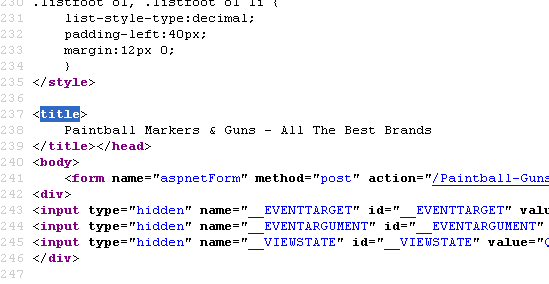 Does the location of the title tag, meta tags, and any structured data have any influence with respect to SEO and search engines? Put another way, could we benefit from moving the title tag up to the top?
I "surfed 'n surfed" and could not find any articles about this.
I would really appreciate any help on this as our site got decimated organically last May and we are looking for any help with SEO.
NIck
0
Does the location of the title tag, meta tags, and any structured data have any influence with respect to SEO and search engines? Put another way, could we benefit from moving the title tag up to the top?
I "surfed 'n surfed" and could not find any articles about this.
I would really appreciate any help on this as our site got decimated organically last May and we are looking for any help with SEO.
NIck
0 -

Image Height/Width attributes, how important are they and should a best practice site include this as std
Hi How important are the image height/width attributes and would you expect a best practice site to have them included ? I hear not having them can slow down a page load time is that correct ? Any other issues from not having them ? I know some re social sharing (i know bufferapp prefers images with h/w attributes to draw into their selection of image options when you post) Most importantly though would you expect them to be intrinsic to sites that have been designed according to best practice guidelines ? Thanks
Technical SEO | | Dan-Lawrence0 -

Can I format my H1 to be smaller than H2's and H3's on the same page?
I would like to create a web design with 12px H1 and for sub headings on the page to be more like 24px. Will search engines see this and dislike it? The reason for doing it is that I want to put a generic page title in the banner, and more poetic headings above the main body. Example: Small H1: Wholesale coffee, online coffee shop and London roastery Large h2: Respect the bean... Thanks
Technical SEO | | Crumpled_Dog
Scott0 -

What's the difference between a category page and a content page
Hello, Little confused on this matter. From a website architectural and content stand point, what is the difference between a category page and a content page? So lets say I was going to build a website around tea. My home page would be about tea. My category pages would be: White Tea, Black Tea, Oolong Team and British Tea correct? ( I Would write content for each of these topics on their respective category pages correct?) Then suppose I wrote articles on organic white tea, white tea recipes, how to brew white team etc...( Are these content pages?) Do I think link FROM my category page ( White Tea) to my ( Content pages ie; Organic White Tea, white tea receipes etc) or do I link from my content page to my category page? I hope this makes sense. Thanks, Bill
Technical SEO | | wparlaman0 -

A question about RSS feeds and nofollow's
With the nofollow tag used very widely on the internet these days I was just wondering about how an RSS feed might help me find a way around it. Basically my question is this : I post a comment on a blog, it's approved and my comment together with my link(nofollow tag applied) is there. Now when the blogs RSS feed updates, does this nofollow tag get applied to the feed? As far as I can tell it does not - but I'm not too clue'd up on how the feed is generated. Anyone want to help me understand how it works and if what I'm suggesting would be 'a way around the nofollow tag' ? Thanks 🙂
Technical SEO | | DanHill0