Moz Q&A is closed.
After more than 13 years, and tens of thousands of questions, Moz Q&A closed on 12th December 2024. Whilst we’re not completely removing the content - many posts will still be possible to view - we have locked both new posts and new replies. More details here.
How to stop google from indexing specific sections of a page?
-
I'm currently trying to find a way to stop googlebot from indexing specific areas of a page, long ago Yahoo search created this tag class=”robots-nocontent” and I'm trying to see if there is a similar manner for google or if they have adopted the same tag?
Any help would be much appreciated.
-
Unfortunately, there is no officially sanctioned method for blocking just a portion of a page from the index. As others have mentioned, there are tricks that might do it, but their effectiveness is inconsistent, and most of them will run the risk that Google could treat it as a red flag of some sort. More often, the results just end up being unpredictable (especially with JavaScript) and end up causing additional grief for your developers and visitors.
Most of the time, if you're dealing with substantial amounts of content you don't want indexed, I'd look for other solutions, such as grouping that content or making sure more of your content on any given page is unique. Unfortunately, that depends a lot on why you want it blocked, so it's hard to give a one-size-fits-all answer.
-
We have just had a similar conundrum and plumped for the iframe option, sticking robots.txt on the iframe's source
-
I don't know this to be a fact, but I would not be surprised that if you could hide specific content on a page from Google, it would not be the best trust signal and could have it's own downside.
-
Google is getting much better at reading javascript, however.
-
I'm going to avoid iframes but the javascript does sound the best option so far, thank you!
-
You might try Inserting your text into Javascript or maybe, inserting it into an Iframe.
-
ah ok looks like I still need to look into this further, if you do find anything I would love to hear how you can achieve it as I think it would be a useful technique to implement in some projects.
-
Ahhh unfortunately the googleon / off tags is only in conjunction with Google search appliance, if that's changed though it would be incredibly useful.
-
Here is the article where this was taken from - http://perishablepress.com/tell-google-to-not-index-certain-parts-of-your-page/
-
This is a good question and something I haven't looked into. From articles I've read I think this may be what you are searching for.
 <code>This is normal (X)HTML content that will be indexed by Google.

This (X)HTML content will NOT be indexed by Google.</code>







Got a burning SEO question?
Subscribe to Moz Pro to gain full access to Q&A, answer questions, and ask your own.
Browse Questions
Explore more categories
-
Moz Tools
Chat with the community about the Moz tools.
-
SEO Tactics
Discuss the SEO process with fellow marketers
-
Community
Discuss industry events, jobs, and news!
-
Digital Marketing
Chat about tactics outside of SEO
-
Research & Trends
Dive into research and trends in the search industry.
-
Support
Connect on product support and feature requests.
Related Questions
-

Page Indexing without content
Hello. I have a problem of page indexing without content. I have website in 3 different languages and 2 of the pages are indexing just fine, but one language page (the most important one) is indexing without content. When searching using site: page comes up, but when searching unique keywords for which I should rank 100% nothing comes up. This page was indexing just fine and the problem arose couple of days ago after google update finished. Looking further, the problem is language related and every page in the given language that is newly indexed has this problem, while pages that were last crawled around one week ago are just fine. Has anyone ran into this type of problem?
Technical SEO | | AtuliSulava1 -

Google is indexing bad URLS
Hi All, The site I am working on is built on Wordpress. The plugin Revolution Slider was downloaded. While no longer utilized, it still remained on the site for some time. This plugin began creating hundreds of URLs containing nothing but code on the page. I noticed these URLs were being indexed by Google. The URLs follow the structure: www.mysite.com/wp-content/uploads/revslider/templates/this-part-changes/ I have done the following to prevent these URLs from being created & indexed: 1. Added a directive in my Htaccess to 404 all of these URLs 2. Blocked /wp-content/uploads/revslider/ in my robots.txt 3. Manually de-inedex each URL using the GSC tool 4. Deleted the plugin However, new URLs still appear in Google's index, despite being blocked by robots.txt and resolving to a 404. Can anyone suggest any next steps? I Thanks!
Technical SEO | | Tom3_150 -

Indexing Issue of Dynamic Pages
Hi All, I have a query for which i am struggling to find out the answer. I unable to retrieve URL using "site:" query on Google SERP. However, when i enter the direct URL or with "info:" query then a snippet appears. I am not able to understand why google is not showing URL with "site:" query. Whether the page is indexed or not? Or it's soon going to be deindexed. Secondly, I would like to mention that this is a dynamic URL. The index file which we are using to generate this URL is not available to Google Bot. For instance, There are two different URL's. http://www.abc.com/browse/ --- It's a parent page.
Technical SEO | | SameerBhatia
http://www.abc.com/browse/?q=123 --- This is the URL, generated at run time using browse index file. Google unable to crawl index file of browse page as it is unable to run independently until some value will get passed in the parameter and is not indexed by Google. Earlier the dynamic URL's were indexed and was showing up in Google for "site:" query but now it is not showing up. Can anyone help me what is happening here? Please advise. Thanks0 -

Site indexed by Google, but (almost) never gets impressions
Hi there, I have a question that I wasn't able to give it a reasonable answer yet, so I'm going to trust on all of you. Basically a site has all its pages indexed by Google (I verified with site:sitename.com) and it also has great and unique content. All on-page grades are A with absolutely no negative factors at all. However its pages do not get impressions almost at all. Of course I didn't expect it to be on page 1 since it has been launched on Dec, 1st, but it looks like Google is ignoring (or giving it bad scores) for some reason. Only things that can contribute to that could be: domain privacy on the domain, redirect from the www to the subdomain we use (we did this because it will be a multi-language site, so we'll assign to each country a subdomain), recency (it has been put online on Dec 1st and the domain is just a couple of months old). Or maybe because we blocked crawlers for a few days before the launch? Exactly a few days before Dec 1st. What do you think? What could be the reason for that? Thanks guys!
Technical SEO | | ruggero0 -

Google stopped crawling my site. Everybody is stumped.
This has stumped the Wordpress staff and people in the Google Webmasters forum. We are in Google News (have been for years), and so new posts are crawled immediately. On Feb 17-18 Crawl Stats dropped 85%, and new posts were no longer indexed (not appearing on News or search). Data highlighter attempts return "This URL could not be found in Google's index." No manual actions by Google. No changes to the website; no custom CSS. No Site Errors or new URL errors. No sitemap problems (resubmitting didn't help). We're on wordpress.com, so no odd code. We can see the robot.txt file. Other search engines can see us, as can social media websites. Older posts still index, but loss of News is a big hit. Also, I think overall Google referrals are dropping. We can Fetch the URL for a new post, and many hours later it appears on Google and News, and we can then use Data Highlighter. It's now 6 days and no recovery. Everybody is stumped. Any ideas? I just joined, so this might be the wrong venue. If so, apologies.
Technical SEO | | Editor-FabiusMaximus_Website0 -

How to block text on a page to be indexed?
I would like to block the spider indexing a block of text inside a page , however I do not want to block the whole page with, for example , a noindex tag. I have tried already with a tag like this : chocolate pudding chocolate pudding However this is not working for my case, a travel related website. thanks in advance for your support. Best regards Gianluca
Technical SEO | | CharmingGuy0 -
Image Indexing Issue by Google
Hello All,My URL is: www.thesalebox.comI have Submitted my image Sitemap in google webmaster tool on 10th Oct 2013,Still google could not indexing any of my web images,Please refer my sitemap - www.thesalebox.com/AppliancesHomeEntertainment.xml and www.thesalebox.com/Hardware.xmland my webmaster status and image indexing status are below,
Technical SEO | | CommercePundit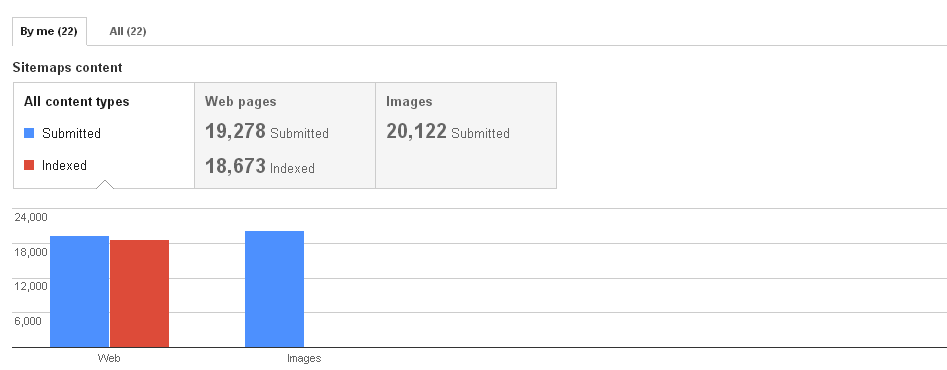 Can you please help me, why my images are not indexing in google yet? is there any issue? please give me suggestions?Thanks!
0
Can you please help me, why my images are not indexing in google yet? is there any issue? please give me suggestions?Thanks!
0 -

How long does it take for Google for deindexing pages?
Hi mozzers, We just launched a mobile website(parallel) and realized that it created many duplicate content with desktop URLs. I decided to add name="robots" content="No index, No follow" /> to the entire mobile site. My only concern is that I am still seeing the mobile site indexed when it's been almost a week I added these tags. Does anyone know how long it takes google to deindex your content? Thanks
Technical SEO | | Ideas-Money-Art0
