Moz Q&A is closed.
After more than 13 years, and tens of thousands of questions, Moz Q&A closed on 12th December 2024. Whilst we’re not completely removing the content - many posts will still be possible to view - we have locked both new posts and new replies. More details here.
Title Tag vs. H1 / H2
-
OK, Title tag, no problem, it's the SEO juice, appears on SERP, etc. Got it.
But I'm reading up on H1 and getting conflicting bits of information ...
- Only use H1 once?
- H1 is crucial for SERP
- Use H1s for subheads
- Google almost never looks past H2 for relevance
So say I've got a blog post with three sections ... do I use H1 three times (or does Google think you're playing them ...)
Or do I create a "big" H1 subhead and then use H2s? Or just use all H2s because H1s are scary?

I frequently use subheads, it would seem weird to me to have one a font size bigger than another, but of course I can adjust that in settings ...
Thoughts?
Lisa
-
Let me add that
- In many cases the title tag will also contain the website's name, as in
<title>Awesome Cool Headline | website name<title></li> <li>A good CMS will let you differentiate between headline in title and headline on the page (the H1)</li> <li>If your website is indexed by Google News the shown headline will be the H1, not the title tag</li> </ul></title>
- In many cases the title tag will also contain the website's name, as in
-
<title>Awesome Cool Headline<title></p> <p><H1>Awesome Cool Headline<H1></p> <p>This looks correct. Then use H2 for subheadings. The title won't get printed on the page so "Awesome Cool Headline" will only show once on the page content.</p></title>
-
OK, getting more information ... I think the issue here is this is for a blog and I'm thinking the Title tag usurps the H1.
For a blog, it would be:
<title>Awesome Cool Headline<title></p> <p><H1>Awesome Cool Headline<H1></p> <p>which would look redundant. So I think I could use the first subhead as an H1 if it was written in a way that was relevant to the story, but I'm guessing best practices are H2. Although if I did that, I'd NEVER have an H1 on my pages unless I was doing a landing page promotion of some sort ... hmmm.</p></title>
-
Ah, so ...
- Title (duh)
- H1 header (use as first subhead after lead graph to set the tone for the piece?)
- H2 for all other subheads
- Set H1 and H2 at the same font style so no one knows the difference.
Can someone give me a good example of an H1? I don't know why I'm a bit stuck on the H1 application, but a few in the wild examples should help. This is truly appreciated guys!
Thanks!
-
Like others have mentioned you should only have one H1. This should appear on the page before any other headings such as h2, h3 etc.
The styling shouldn't matter so the h1 doesn't need to be in a larger font size than the h2's.
-
Of the 4 points you mention you've seen, I'd say the only one that's entirely incorrect is #3.
1. Only use H1 once: True. Think of it like a book title. That's the most important thing, so nothing else should share that prominence.
2. H1 is crucial for SERP: **True. **This is what Google looks to, after your title tag, for information about your page and the content therein. This reaffirms that your metadata, keywords, title, content, etc. are all related - while also showing visitors what this page is about (Google values visitor experience more and more with each update).
3. Use H1s for subheads. False. Think back to #1 - H1 should be reserved only for the 1 absolute most important thing (which should be your title).
4. Google almost never looks past H2 for relevance. Kind of true. Google DOES look beyond this (and even parses your body-text), but with each lowering of prominence / heading, Google gives it less weight. #4 is true in the sense that this weight is lessened significantly, but it's incorrect generally - your content is still very important.
I hope this has been helpful to you! Good luck!
-
Just use H1 one time, matt cutts said in a video that he would like to see only 1 H1 tag on a page.
Create content for better user experience, use headings just for your readers, and don't follow these on page tactics very much. Now everyone knows these techniques, and I don't think Google gives higher weight to these things.
Create content for readers
Use H1 as your Page's Heading(Just one time)
Use H2 where you think it's essential





Got a burning SEO question?
Subscribe to Moz Pro to gain full access to Q&A, answer questions, and ask your own.
Browse Questions
Explore more categories
-
Moz Tools
Chat with the community about the Moz tools.
-
SEO Tactics
Discuss the SEO process with fellow marketers
-
Community
Discuss industry events, jobs, and news!
-
Digital Marketing
Chat about tactics outside of SEO
-
Research & Trends
Dive into research and trends in the search industry.
-
Support
Connect on product support and feature requests.
Related Questions
-

Hidden H1 Tag on Image
Hi, In the page I'm working on, I encountered an tag in an image, rather than in a text form. Do you think it's an issue when it comes to SEO?
Technical SEO | | nerdieb
What do you suggest I should do if there is an issue? Keen to hear from you!0 -

Does Title Tag location in a page's source code matter?
Currently our meta description is on line 8 for our page - http://www.paintball-online.com/Paintball-Guns-And-Markers-0Y.aspx
Technical SEO | | Istoresinc The title tag, however sits below a bunch of code on line 237
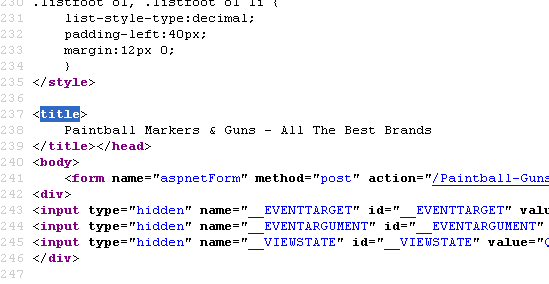 Does the location of the title tag, meta tags, and any structured data have any influence with respect to SEO and search engines? Put another way, could we benefit from moving the title tag up to the top?
I "surfed 'n surfed" and could not find any articles about this.
I would really appreciate any help on this as our site got decimated organically last May and we are looking for any help with SEO.
NIck
0
Does the location of the title tag, meta tags, and any structured data have any influence with respect to SEO and search engines? Put another way, could we benefit from moving the title tag up to the top?
I "surfed 'n surfed" and could not find any articles about this.
I would really appreciate any help on this as our site got decimated organically last May and we are looking for any help with SEO.
NIck
0 -

Canonical tag for Home page: with or without / at the end???
Setting up canonical tags for an old site. I really need advice on that darn backslash / at the end of the homepage URL. We have incoming links to the homepage as http://www.mysite.com (without the backslash), and as http://www.mysite.com/ (with the backslash), and as http://www.mysite.com/index.html I know that there should be 301 redirects to just one version, but I need to know more about the canonical tags... Which should the canonical tag be??? (without the backslash) or (with the backslash) Thanks for your help! 🙂
Technical SEO | | GregB1230 -

Page titles in browser not matching WP page title
I have an issue with a few page titles not matching the title I have In WordPress. I have 2 pages, blog & creative gallery, that show the homepage title, which is causing duplicate title errors. This has been going on for 5 weeks, so its not an a crawl issue. Any ideas what could cause this? To clarify, I have the page title set in WP, and I checked "Disable PSP title format on this page/post:"...but this page is still showing the homepage title. Is there an additional title setting for a page in WP?
Technical SEO | | Branden_S0 -

Using a non-visible H1
I have a developer that wants to use style="text-indent:-9999px" to make the H1 non-visible to the user. Being the conservative person I am, I've never tried this before and worry that Search Engines may think this is a form of cloaking. Am I worrying about nothing? And apologies if it's already been covered here. I couldn't find it. Thanks in advance!!!!
Technical SEO | | elytical0 -

How should I shorten my titles?
I've read that page titles can't/shouldn't be more than 70 characters long. Out of around 1,000 products we have about 150 that have legitimate titles that exceed this character limitation. We plan on automatically truncating these. Should I just cut the titles off at 70 characters or should I cut them off and add a "..."? Does it even matter?
Technical SEO | | dbuckles0 -

Img before or after h1 tag?
I like images to align right at top of content page. img tag before h1 tag looks better on page, but wondering if h1 tag before img tag is preferred by spider. Irrelevant? or possibly matters? thanks for any thoughts.
Technical SEO | | jotham2
All about Stuff or All about Stuff or even
All about Stuff0 -

Use of Meta Tag - MSSmartTagsPreventParsing
We've inherited some sites from another developer that had the following tag: All references I can find to it are from 2004. What is the purpose and is it worth including in pages/sites we build?
Technical SEO | | wcksmith0