Moz Q&A is closed.
After more than 13 years, and tens of thousands of questions, Moz Q&A closed on 12th December 2024. Whilst we’re not completely removing the content - many posts will still be possible to view - we have locked both new posts and new replies. More details here.
What are best options for website built with navigation drop-down menus in JavaScript, to get those menus indexed by Google?
-
This concerns f5.com, a large website with navigation menus that drop down when hovered over. The sub nav items (example: “DDoS Protection”) are not cached by Google and therefore do not distribute internal links properly to help those sub-pages rank well.
Best option naturally is to change the nav menus from JS to CSS but barring that, is there another option? Will Schema SiteNavigationElement work as an alternate?
-
Meh, I guess not.
 It's just like talking about it to clients or friends. I've made some fine noise with lots of technical words.
 -
Hi Carl - Did you see Travis' thoughtful response to your question?
-
I would generally prefer CSS over JS for navigational elements, but that probably isn't the problem here. Google can crawl JavaScript and attribute links fine. And per SEM Rush, it looks like the site is enjoying a pretty sharp uptick in organic traffic recently. That would seem to be at odds with big indexation problems.
I'm not so sure if it's my network, I'm on a sub par connection now, but I noticed that some CSS and JS files were timing out when I crawled the site. That could lead to a big problem. I would advise that someone check the server log files and see if those files are regularly timing out. Ideally one would want their CSS and JS files combined/concatenated where possible, to reduce the possibility of any such rendering issues.
More on that from SE Roundtable
I checked the cache for the EN version of a few of those pages, and they appear to be cached fine.
cache:https://f5.com/products/security/distributed-denial-of-service-ddos-protection yields, which is pretty much what we want.
But I do see some problems that could lead to problems with indexation/display. The site has a number of different languages/translations. However, I noticed that the hreflang attribute was missing. It's strongly recommended that hreflang is implemented. You're good on the language meta tag Bing recommends, though.
That would cause some problems, especially on a site that large. I've researched Radware, their competitor, years ago. F5 seems like the type of organization that would pay for a decent translation. (my German and Spanish are so limited, I couldn't discern the quality of the translations) But if it is automatically generated, that would more than likely lead to indexation problems as well.
Another thing I see is that each translation is marked as canonical. This could also cause problems with display and link equity.

Here's more on internationalization from Moz and Google.
I would also look for ways to build internal links to the important products (DDoS Mitigation is supposed to be a huge money maker now.) on the home page, in the body. Not just in boilerplate (nav... footer... etc....) areas.
Edit: Forgot to mention that the mobile menu doesn't appear to directly link important products. I would make sure the experience is the same across devices.



Got a burning SEO question?
Subscribe to Moz Pro to gain full access to Q&A, answer questions, and ask your own.
Browse Questions
Explore more categories
-
Moz Tools
Chat with the community about the Moz tools.
-
SEO Tactics
Discuss the SEO process with fellow marketers
-
Community
Discuss industry events, jobs, and news!
-
Digital Marketing
Chat about tactics outside of SEO
-
Research & Trends
Dive into research and trends in the search industry.
-
Support
Connect on product support and feature requests.
Related Questions
-

My Website's Home Page is Missing on Google SERP
Hi All, I have a WordPress website which has about 10-12 pages in total. When I search for the brand name on Google Search, the home page URL isn't appearing on the result pages while the rest of the pages are appearing. There're no issues with the canonicalization or meta titles/descriptions as such. What could possibly the reason behind this aberration? Looking forward to your advice! Cheers
Technical SEO | | ugorayan0 -

Google not Indexing images on CDN.
My URL is: https://bit.ly/2hWAApQ We have set up a CDN on our own domain: https://bit.ly/2KspW3C We have a main xml sitemap: https://bit.ly/2rd2jEb and https://bit.ly/2JMu7GB is one the sub sitemaps with images listed within. The image sitemap uses the CDN URLs. We verified the CDN subdomain in GWT. The robots.txt does not restrict any of the photos: https://bit.ly/2FAWJjk. Yet, GWT still reports none of our images on the CDN are indexed. I ve followed all the steps and still none of the images are being indexed. My problem seems similar to this ticket https://bit.ly/2FzUnBl but however different because we don't have a separate image sitemap but instead have listed image urls within the sitemaps itself. Can anyone help please? I will promptly respond to any queries. Thanks
Technical SEO | | TNZ
Deepinder0 -

Why google indexed pages are decreasing?
Hi, my website had around 400 pages indexed but from February, i noticed a huge decrease in indexed numbers and it is continually decreasing. can anyone help me to find out the reason. where i can get solution for that? will it effect my web page ranking ?
Technical SEO | | SierraPCB0 -

Sitemap indexed pages dropping
About a month ago I noticed my pages indexed from my sitemap are dropping.There are 134 pages in my sitemap and only 11 are indexed. It used to be 117 pages and just died off quickly. I still seem to be getting consistant search traffic but I'm just not sure whats causing this. There are no warnings or manual actions required in GWT that I can find.
Technical SEO | | zenstorageunits0 -

How to fix Google index after fixing site infected with malware.
Hi All Upgraded a Joomla site for a customer a couple of months ago that was infected with malware (it wasn't flagged as infected by google). Site is fine now but still noticing search queries for "cheap adobe" etc with links to http://domain.com/index.php?vc=201&Cheap_Adobe_Acrobat_xi in web master tools (about 50 in total). These url's redirect back to home page and seem to be remaining in the index (I think Joomla is doing this automatically) Firstly, what sort of effect would these be having on on their rankings? Would they be seen by google as duplicate content for the homepage (moz doesn't report them as such as there are no internal links). Secondly what's my best plan of attack to fix them. Should I setup 404's for them and then submit them to google? Will resubmitting the site to the index fix things? Would appreciate any advice or suggestions on the ramifications of this and how I should fix it. Regards, Ian
Technical SEO | | iragless0 -
Image Indexing Issue by Google
Hello All,My URL is: www.thesalebox.comI have Submitted my image Sitemap in google webmaster tool on 10th Oct 2013,Still google could not indexing any of my web images,Please refer my sitemap - www.thesalebox.com/AppliancesHomeEntertainment.xml and www.thesalebox.com/Hardware.xmland my webmaster status and image indexing status are below,
Technical SEO | | CommercePundit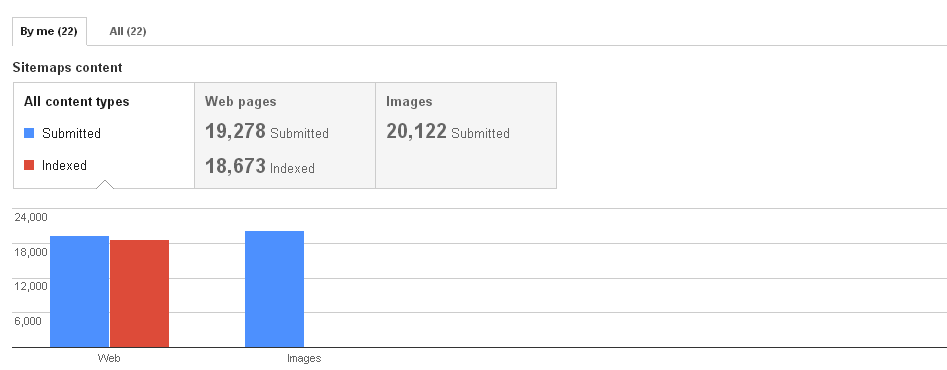 Can you please help me, why my images are not indexing in google yet? is there any issue? please give me suggestions?Thanks!
0
Can you please help me, why my images are not indexing in google yet? is there any issue? please give me suggestions?Thanks!
0 -

How to Stop Google from Indexing Old Pages
We moved from a .php site to a java site on April 10th. It's almost 2 months later and Google continues to crawl old pages that no longer exist (225,430 Not Found Errors to be exact). These pages no longer exist on the site and there are no internal or external links pointing to these pages. Google has crawled the site since the go live, but continues to try and crawl these pages. What are my next steps?
Technical SEO | | rhoadesjohn0

