Moz Q&A is closed.
After more than 13 years, and tens of thousands of questions, Moz Q&A closed on 12th December 2024. Whilst we’re not completely removing the content - many posts will still be possible to view - we have locked both new posts and new replies. More details here.
Why Product pages are throwing Missing field "image" and Missing field "price" in Wordpress Woocommerce
-
I have a wordpress wocommerce website where I have uploaded 100s of products but it's giving me error in GSC under merchant listing tab. When I tested it show missing field image and missing field price. I have done everything according to https://developers.google.com/search/docs/appearance/structured-data/product#merchant-listing-experiences and applied fixed i.e. images are 800x800 and price range is also there. What else can be done here?!
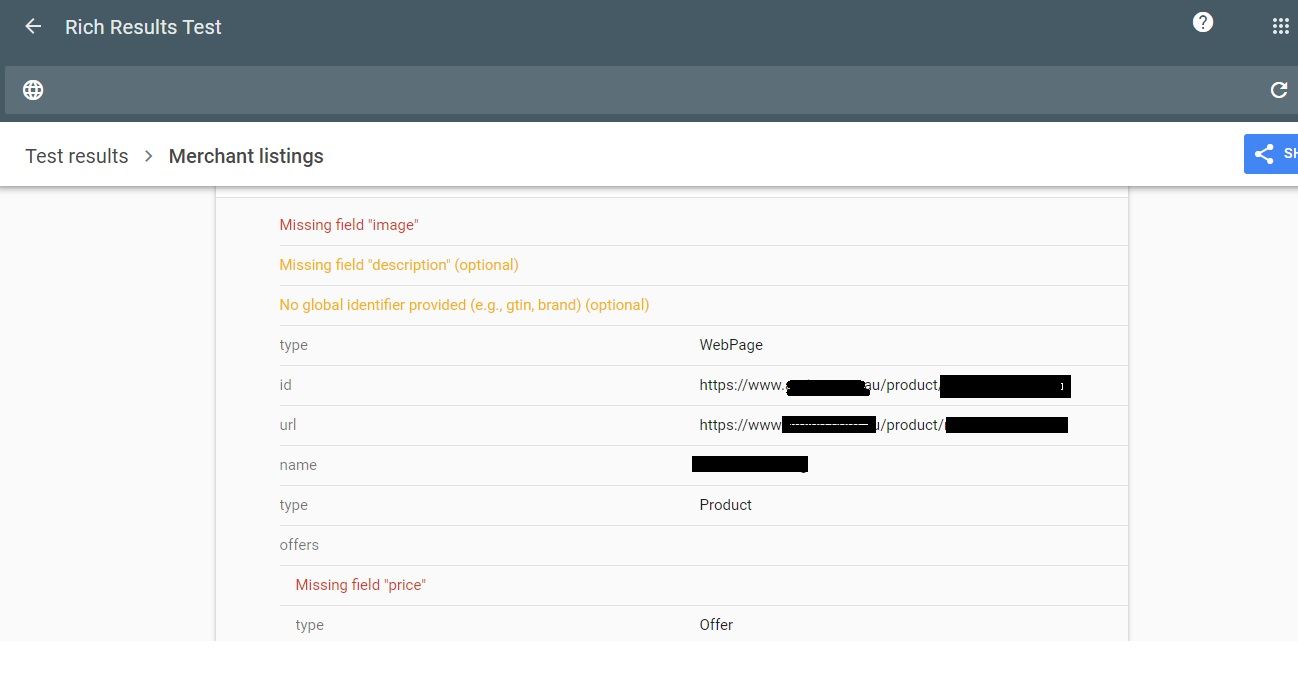
-
The "Missing field 'image' and 'price'" errors in WordPress WooCommerce product pages typically indicate that some product listings are incomplete or lacking essential information. To resolve this, ensure that you have properly configured product images and prices for all your items in the WooCommerce backend. This will help provide a better shopping experience for your customers. If you need more guidance on how to fix these issues, please let me know.
-
Hey, it sounds like there might be a configuration issue with the product pages. Have you checked if the 'image' and 'price' fields are properly Nedbank Branch Code filled for each product in the WooCommerce settings? Double-checking those might solve the problem. Let me know how it goes!
-
I'm sorry to hear about the trouble you're facing. This issue might stem from incomplete product listings in your WooCommerce setup. Ensure that each product has a designated image and price specified. Also, double-check any custom fields or plugins that might affect this. If the problem persists, Nedbank Branch Code reaching out to WooCommerce support or consulting the community forums could provide further assistance. Good luck!
-
I'm sorry to hear about the trouble you're facing. It sounds like you've followed the structured data guidelines correctly. Double-check that there are no typos or discrepancies in your code. Also, ensure your website is properly indexed by Google. If the issue persists, consider reaching out to Google Support for more specific guidance. Good luck getting it sorted!



Got a burning SEO question?
Subscribe to Moz Pro to gain full access to Q&A, answer questions, and ask your own.
Browse Questions
Explore more categories
-
Moz Tools
Chat with the community about the Moz tools.
-
SEO Tactics
Discuss the SEO process with fellow marketers
-
Community
Discuss industry events, jobs, and news!
-
Digital Marketing
Chat about tactics outside of SEO
-
Research & Trends
Dive into research and trends in the search industry.
-
Support
Connect on product support and feature requests.
Related Questions
-

Unsolved Need Moz SEO Wordpress Plugin With API
Re: Moz WordPress Plugin? Hi guys,
Moz Pro | | mrezair
I need some Moz SEO Wordpress Plugins For my website working with Moz API. I've already found Moz DA-PA Checker plugin Moz DA-PA Checker But Need SEO Plugins too. Any Suggestion will be appreciated.0 -

Redirection of 100 domain to Main domain affects SEO?
Hi guys, An email software vendor managed by a different area of my company redirected 100 domains used for unsolicited email campaigns to my main domain. These domains are very likely to get blacklisted at some point. My SEO tool now is showing me all those domains as "linking" to my main site as do-follow links. The vendor states that this will not affect my main domain/website in any way. I'm highly concerned. I would appreciate your professional opinion about this. Thanks!!
Intermediate & Advanced SEO | | anagentile0 -

How to get rid of bad backlinks
So I noticed my rankings going down and spam score going up. So under my spam score there are over 100 links for different websites but ALL redirect to semalt.com I researched it and it says they hijacked a bunched of backlinks but don't know much more. How can I get rid of all those backlinks? I was told I could use the disavow tool but apparently that can hurt my ranking as well. The semalt.com site has no backlink to me - it looks like the pages that have/had my backlinks, they've redirected to them. For instance this is one of the links http://www.oxvideos.xyz/indianantyphotoxxx 422005fb-9240-40a4-8b65-f5b1f5079dea-image.png
Link Building | | landlwoof40 -

Is page speed important to improve SEO ranking?
I saw on a SEO Agency's site (https://burstdgtl.com/search-engine-optimization/) that page speed apparently affects Google ranking. Is this true? And if it is, how do I improve it, do I need an agency?
On-Page Optimization | | jasparcj0 -

Product Images with organic results in SERP
Hey Mozzers, I've noticed that several of our product page results in Google have the product image associated with them. Today is the first day I've seen this. Does anyone know anything about these? Has Google put anything out about this? Here's a couple examples: http://content.screencast.com/users/Will_Swales/folders/Jing/media/08a16dcf-505e-443c-866d-fae6d805743e/2014-03-31_1031.png http://content.screencast.com/users/Will_Swales/folders/Jing/media/04972e7b-f6b2-4e78-ab11-95c52d69a200/2014-03-31_1056.png What's interesting is that they don't show for me when I use Chrome's Incognito mode. Any insights much appreciated! Will
Technical SEO | | evoNick4 -

Determining When to Break a Page Into Multiple Pages?
Suppose you have a page on your site that is a couple thousand words long. How would you determine when to split the page into two and are there any SEO advantages to doing this like being more focused on a specific topic. I noticed the Beginner's Guide to SEO is split into several pages, although it would concentrate the link juice if it was all on one page. Suppose you have a lot of comments. Is it better to move comments to a second page at a certain point? Sometimes the comments are not super focused on the topic of the page compared to the main text.
Technical SEO | | ProjectLabs1 -

Is it worth setting up 301 redirects from old products to new products?
This year we are using a new supplier and they have provided us a product database of approx. 5k products. About 80% of these products were in our existing database but once we have installed the new database all the URLs will have changed. There is no quick way to match the old products with the new products so we would have to manually match all 5k products if we were were to setup 301 rules for the old products pointing to the new products. Of course this would take a lot of time. So the options are: 1. Is it worth putting in this effort to make the 301 rules? 2. Or are we okay just to delete the old product pages, let the SE see the 404 and just wait for it to index the new pages? 3. Or, as a compromise, should we 301 the old product page to the new category page as this is a lot quicker for us do do than redirecting to the new product page?
Technical SEO | | indigoclothing0 -

Why "title missing or empty" when title tag exists?
Greetings! On Dec 1, 2011 in a SEOMoz campaign, two crawl metrics shot up from zero (Nov 17, Nov 24). "Title missing or empty" was 9,676. "Duplicate page content" was 9,678. Whoa! Content at site has not changed. I checked a sample of web pages and each seems to have a proper TITLE tag. Page content differs as well -- albeit we list electronic part numbers of hard-to-find parts, which look similar. I found a similar post http://www.seomoz.org/q/why-crawl-error-title-missing-or-empty-when-there-is-already-title-and-meta-desciption-in-place . In answer, Sha ran Screaming Frog crawler. I ran Frog crawler on a few hundred pages. Titles were found and hash codes were unique. Hmmm. Site with errors is http://electronics1.usbid.com Small sample of pages with errors: electronics1.usbid.com/catalog_10.html
Technical SEO | | groovykarma
electronics1.usbid.com/catalog_100.html
electronics1.usbid.com/catalog_1000.html I've tried to reproduce errors yet I cannot. What am I missing please? Thanks kindly, Loren0