Moz Q&A is closed.
After more than 13 years, and tens of thousands of questions, Moz Q&A closed on 12th December 2024. Whilst we’re not completely removing the content - many posts will still be possible to view - we have locked both new posts and new replies. More details here.
Multiple H1 Tags on Page
-
Can having multiple H1 tags on a webpage be detrimental to its rankings?
-
Hello Chad,
Absolutely, depending on how you structure your tags. The biggest problem with multiple H1's is that using different keywords can confuse Google and Users about what a page is attempting to rank for. If you have multiple keywords you are attempting to rank for, you are better off creating different pages with a small number of H1's optimized to each keyword respectively. This will help Google contextualize the page.
This comes up frequently on Moz Q&A, and opinion has shifted throughout the years, but it is now considered best practice to use a single keyword/H1 tag for each page for best ranking potential.
Hope this helps,
Rob
-
Just like you want to have a single title tag you want to optimally have a single H1. Use of the H1 (and H2 H3s for that matter) helps Google to understand the hierarchy of information on your page. By having multiple H1s you are potentially not giving as clear of a signal of what text is most important on your page. It is also good for users as they can clearly and quickly see what your page is about and increase the chances of staying on your page, thereby reducing bounce rate and potentially increasing conversion rate.
That said, regarding rankings, this all depends. I can't promise that if you fix your H1 that you will rank #1 - there are just too many other factors to consider. Can you rank well with having multiple H1s, sure. Google still may be able to "figure it out".
Still, best practice is to have a single H1 as far as what most SEOs (and SEOs that I respect) recommend and this is what I do on all of my sites.
Some other posts on this topic that are of this ilk:
https://azwa.1clkaccess.in/community/q/h1-tag
http://www.searchenginejournal.com/in-2014-how-important-is-an-h1-tag-for-seo/
https://azwa.1clkaccess.in/community/q/how-to-peroperly-use-h1-h2-and-h3-tag-on-your-website
http://www.seobythesea.com/2012/01/heading-elements-and-the-folly-of-seo-expert-ranking-lists/



Got a burning SEO question?
Subscribe to Moz Pro to gain full access to Q&A, answer questions, and ask your own.
Browse Questions
Explore more categories
-
Moz Tools
Chat with the community about the Moz tools.
-
SEO Tactics
Discuss the SEO process with fellow marketers
-
Community
Discuss industry events, jobs, and news!
-
Digital Marketing
Chat about tactics outside of SEO
-
Research & Trends
Dive into research and trends in the search industry.
-
Support
Connect on product support and feature requests.
Related Questions
-

Dynamic Canonical Tag for Search Results Filtering Page
Hi everyone, I run a website in the travel industry where most users land on a location page (e.g. domain.com/product/location, before performing a search by selecting dates and times. This then takes them to a pre filtered dynamic search results page with options for their selected location on a separate URL (e.g. /book/results). The /book/results page can only be accessed on our website by performing a search, and URL's with search parameters from this page have never been indexed in the past. We work with some large partners who use our booking engine who have recently started linking to these pre filtered search results pages. This is not being done on a large scale and at present we only have a couple of hundred of these search results pages indexed. I could easily add a noindex or self-referencing canonical tag to the /book/results page to remove them, however it’s been suggested that adding a dynamic canonical tag to our pre filtered results pages pointing to the location page (based on the location information in the query string) could be beneficial for the SEO of our location pages. This makes sense as the partner websites that link to our /book/results page are very high authority and any way that this could be passed to our location pages (which are our most important in terms of rankings) sounds good, however I have a couple of concerns. • Is using a dynamic canonical tag in this way considered spammy / manipulative? • Whilst all the content that appears on the pre filtered /book/results page is present on the static location page where the search initiates and which the canonical tag would point to, it is presented differently and there is a lot more content on the static location page that isn’t present on the /book/results page. Is this likely to see the canonical tag being ignored / link equity not being passed as hoped, and are there greater risks to this that I should be worried about? I can’t find many examples of other sites where this has been implemented but the closest would probably be booking.com. https://www.booking.com/searchresults.it.html?label=gen173nr-1FCAEoggI46AdIM1gEaFCIAQGYARS4ARfIAQzYAQHoAQH4AQuIAgGoAgO4ArajrpcGwAIB0gIkYmUxYjNlZWMtYWQzMi00NWJmLTk5NTItNzY1MzljZTVhOTk02AIG4AIB&sid=d4030ebf4f04bb7ddcb2b04d1bade521&dest_id=-2601889&dest_type=city& Canonical points to https://www.booking.com/city/gb/london.it.html In our scenario however there is a greater difference between the content on both pages (and booking.com have a load of search results pages indexed which is not what we’re looking for) Would be great to get any feedback on this before I rule it out. Thanks!
Technical SEO | | GAnalytics1 -

Page Rank Flow
I wonder if someone can help me understand clearly page rank flow. If we have a website with a Home page, Services, About and Contact as a very basic website and the page rank will flow to each of those pages from the Home page (i'm not including internal linking between pages or anchor text from the home page content - this is a question purely about home page flow via the main navigation). If the Services page had 3 drop down pages. Would the home page rank also flow to each of these or is it going to the Services page which then distributes it to the three drop down. So instead of Home page rank flowing to 3 pages 33% each - it is flowing to 6 pages 16.6% each. Or is it flowing to 3 pages - 33.3% then the Services pages get a third of 33.3% ->10.1% I know this is simplifying it all a great deal- but it is the basic concept I am trying to grasp on this simple example. Thanks
Technical SEO | | AL123al0 -

Brand name as H1 on every page
Hi, Along with the title of each page, a Wordpress client has their brand name as a H1 on every single page. This is situated in the footer and just sits within the company info/address. Should these tags be removed, leaving just the page titles as H1s? Cheers, Lewis
Technical SEO | | PeaSoupDigital0 -

Why is Google Webmaster Tools showing 404 Page Not Found Errors for web pages that don't have anything to do with my site?
I am currently working on a small site with approx 50 web pages. In the crawl error section in WMT Google has highlighted over 10,000 page not found errors for pages that have nothing to do with my site. Anyone come across this before?
Technical SEO | | Pete40 -

Does Title Tag location in a page's source code matter?
Currently our meta description is on line 8 for our page - http://www.paintball-online.com/Paintball-Guns-And-Markers-0Y.aspx
Technical SEO | | Istoresinc The title tag, however sits below a bunch of code on line 237
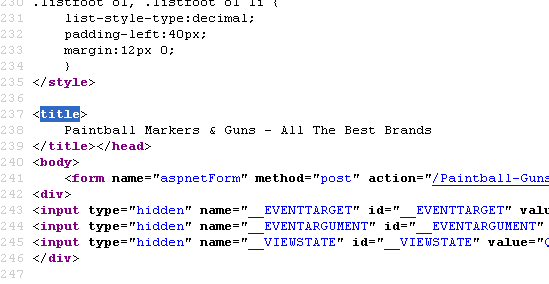 Does the location of the title tag, meta tags, and any structured data have any influence with respect to SEO and search engines? Put another way, could we benefit from moving the title tag up to the top?
I "surfed 'n surfed" and could not find any articles about this.
I would really appreciate any help on this as our site got decimated organically last May and we are looking for any help with SEO.
NIck
0
Does the location of the title tag, meta tags, and any structured data have any influence with respect to SEO and search engines? Put another way, could we benefit from moving the title tag up to the top?
I "surfed 'n surfed" and could not find any articles about this.
I would really appreciate any help on this as our site got decimated organically last May and we are looking for any help with SEO.
NIck
0 -

Do H2 tags carry more weight than h4 tags?
Of course H tags are key signals for relevance in search. Does an h2 tag send a significantly "louder" signal than an h4 tag?
Technical SEO | | aj6130 -

Multiple urls for posting multiple classified ads
Want to optimize referral traffic while at same time keep search engines happy and the ads posted. Have a client who advertises on several classified ad sites around the globe. Which is better (post Panda), having multiple identical urls using canonicals to redirect juice to original url? For example: www.bluewidgets.com is the original www.bluewidgetsusa.com www.blue-widgets-galore.com Or, should the duplicate pages be directed to original using a 301? Currently using duplicate urls. Am currently not using "nofollow" tags on those pages.
Technical SEO | | AllIsWell0
