Moz Q&A is closed.
After more than 13 years, and tens of thousands of questions, Moz Q&A closed on 12th December 2024. Whilst we’re not completely removing the content - many posts will still be possible to view - we have locked both new posts and new replies. More details here.
Removing a canonical tag from Pagination pages
-
Hello,
Currently on our site we have the rel=prev/next markup for pagination along with a self pointing canonical via the Yoast Plugin. However, on page 2 of our paginated series, (there's only 2 pages currently), the canonical points to page one, rather than page 2.
My understanding is that if you use a canonical on paginated pages it should point to a viewall page as opposed to page one. I also believe that you don't need to use both a canonical and the rel=prev/next markup, one or the other will do. As we use the markup I wanted to get rid of the canonical, would this be correct?
For those who use the Yoast Plugin have you managed to get that to work?
Thanks!
-
Any resources on how to get rid of the canonical tag for those pages, and also categories and tags? I found something in Stackoverflow but I'm copying and pasting it into my header.php page and it's not working... so I feel a little clueless. Any ideas?
http://stackoverflow.com/questions/32372589/how-to-remove-rel-canonical-from-tag-pages-in-wordpress
-
Hi Jessica!
You're absolutely correct, use of a canonical on paginated pages should point to a "view all" page as opposed to page 1 of the paginated content. I've heard of the Yoast plugin causing some problems with rel=canonical markup in WP and would suggest getting rid of that canonical (especially if you have rel=prev/next markup).
Hope this helps.
B


Got a burning SEO question?
Subscribe to Moz Pro to gain full access to Q&A, answer questions, and ask your own.
Browse Questions
Explore more categories
-
Moz Tools
Chat with the community about the Moz tools.
-
SEO Tactics
Discuss the SEO process with fellow marketers
-
Community
Discuss industry events, jobs, and news!
-
Digital Marketing
Chat about tactics outside of SEO
-
Research & Trends
Dive into research and trends in the search industry.
-
Support
Connect on product support and feature requests.
Related Questions
-

Getting rid of pagination - redirect all paginated pages or leave them to 404?
Hi all, We're currently in the process of updating our website and we've agreed that one of the things we want to do is get rid of all our pagination (currently used on the blog and product review areas) and instead implement load more on scroll. The question I have is... should we redirect all of the paginated pages and if so, where to? (My initial thoughts were either to the blog homepage or to the archive page) OR do we leave them to just 404? Bear in mind we have thousands of paginated pages 😕 Here's our blog area btw - https://www.ihasco.co.uk/blog Any help would be appreciated, thanks!
Technical SEO | | iHasco0 -

Can I set a canonical tag to an anchor link?
I have a client who is moving to a one page website design. So, content from the inner pages is being condensed in to sections on the 'home' page. There will be a navigation that anchor links to each relevant section. I am wondering if I should leave the old pages and use rel=canonical to point them to their relevant sections on the new 'home' page rather than 301 them. Thoughts?
Technical SEO | | Vizergy0 -

Home Page Ranking Instead of Service Pages
Hi everyone! I've noticed that many of our clients have pages addressing specific queries related to specific services on their websites, but that the Home Page is increasingly showing as the "ranking" page. For example, a plastic surgeon we work with has a page specifically talking about his breast augmentation procedure for Miami, FL but instead of THAT page showing in the search results, Google is using his home page. Noticing this across the board. Any insights? Should we still be optimizing these specific service pages? Should I be spending time trying to make sure Google ranks the page specifically addressing that query because it SHOULD perform better? Thanks for the help. Confused SEO :/, Ricky Shockley
Technical SEO | | RickyShockley0 -

Removed Product page on our website, what to do
We just removed an entire product category on our website, (product pages still exist, but will be removed soon as well) Should we be setting up re-directs, or can we simply delete this category and product
Technical SEO | | DutchG
pages and do nothing? We just received this in Google Webmasters tools: Google detected a significant increase in the number of URLs that return a 404 (Page Not Found) error. We have not updated the sitemap yet...Would this be enough to do or should we do more? You can view our website here: http://tinyurl.com/6la8 We removed the entire "Spring Planted Category"0 -

Why is Google Webmaster Tools showing 404 Page Not Found Errors for web pages that don't have anything to do with my site?
I am currently working on a small site with approx 50 web pages. In the crawl error section in WMT Google has highlighted over 10,000 page not found errors for pages that have nothing to do with my site. Anyone come across this before?
Technical SEO | | Pete40 -

Does Title Tag location in a page's source code matter?
Currently our meta description is on line 8 for our page - http://www.paintball-online.com/Paintball-Guns-And-Markers-0Y.aspx
Technical SEO | | Istoresinc The title tag, however sits below a bunch of code on line 237
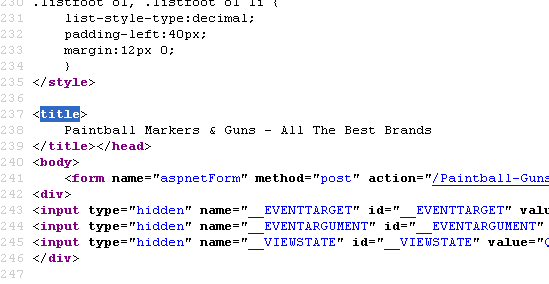 Does the location of the title tag, meta tags, and any structured data have any influence with respect to SEO and search engines? Put another way, could we benefit from moving the title tag up to the top?
I "surfed 'n surfed" and could not find any articles about this.
I would really appreciate any help on this as our site got decimated organically last May and we are looking for any help with SEO.
NIck
0
Does the location of the title tag, meta tags, and any structured data have any influence with respect to SEO and search engines? Put another way, could we benefit from moving the title tag up to the top?
I "surfed 'n surfed" and could not find any articles about this.
I would really appreciate any help on this as our site got decimated organically last May and we are looking for any help with SEO.
NIck
0 -

Can you noindex a page, but still index an image on that page?
If a blog is centered around visual images, and we have specific pages with high quality content that we plan to index and drive our traffic, but we have many pages with our images...what is the best way to go about getting these images indexed? We want to noindex all the pages with just images because they are thin content... Can you noindex,follow a page, but still index the images on that page? Please explain how to go about this concept.....
Technical SEO | | WebServiceConsulting.com0 -

Rel=Canonical on a page with 302 redirection existing
Hi SEOMoz! Can I have the rel=canonical tag on a URL page that has a 302 redirection? Does this harm the search engine friendliness of a content page / website? Thanks! Steve
Technical SEO | | sjcbayona-412180