Moz Q&A is closed.
After more than 13 years, and tens of thousands of questions, Moz Q&A closed on 12th December 2024. Whilst we’re not completely removing the content - many posts will still be possible to view - we have locked both new posts and new replies. More details here.
Robots.txt in subfolders and hreflang issues
-
A client recently rolled out their UK business to the US. They decided to deploy with 2 WordPress installations:
UK site - https://www.clientname.com/uk/ - robots.txt location: UK site - https://www.clientname.com/uk/robots.txt
US site - https://www.clientname.com/us/ - robots.txt location: UK site - https://www.clientname.com/us/robots.txtWe've had various issues with /us/ pages being indexed in Google UK, and /uk/ pages being indexed in Google US.
They have the following hreflang tags across all pages:
We changed the x-default page to .com 2 weeks ago (we've tried both /uk/ and /us/ previously).
Search Console says there are no hreflang tags at all.
Additionally, we have a robots.txt file on each site which has a link to the corresponding sitemap files, but when viewing the robots.txt tester on Search Console, each property shows the robots.txt file for https://www.clientname.com only, even though when you actually navigate to this URL (https://www.clientname.com/robots.txt) you’ll get redirected to either https://www.clientname.com/uk/robots.txt or https://www.clientname.com/us/robots.txt depending on your location.
Any suggestions how we can remove UK listings from Google US and vice versa?
-
Hi there!
Ok, it is difficult to know all the ins and outs without looking at the site, but the immediate issue is that your robots.txt setup is incorrect. robots.txt files should be one per subdomain, and cannot exist inside sub-folders:
A **
robots.txt**file is a file at the root of your site that indicates those parts of your site you don’t want accessed by search engine crawlersFrom Google's page here: https://support.google.com/webmasters/answer/6062608?hl=en
You shouldn't be blocking Google from either site, and attempting to do so may be the problem with why your hreflang directives are not being detected. You should move to having a single robots.txt file located at https://www.clientname.com/robots.txt, with a link to a single sitemap index file. That sitemap index file should then link to each of your two UK & US sitemap files.
You should ensure you have hreflang directives for every page. Hopefully after these changes you will see things start to get better. Good luck!

Got a burning SEO question?
Subscribe to Moz Pro to gain full access to Q&A, answer questions, and ask your own.
Browse Questions
Explore more categories
-
Moz Tools
Chat with the community about the Moz tools.
-
SEO Tactics
Discuss the SEO process with fellow marketers
-
Community
Discuss industry events, jobs, and news!
-
Digital Marketing
Chat about tactics outside of SEO
-
Research & Trends
Dive into research and trends in the search industry.
-
Support
Connect on product support and feature requests.
Related Questions
-

Duplicate titles from hreflang variations
Hi, I am working on a large global site which has around 9 different language variations. We have setup the hreflang tags and referenced the corresponding content as follows: (We have not implemented a version X-default reference, as we felt it was not necessary) Using DeepCrawl and Search Console, we can see that these language variations are causing duplicate title issues. Many of them. My assumption was that the hreflang would have alleviated this issue and informed Google what is going on, however i wanted to see if anyone has any experience with this kind of thing before. It would be good to understand what the best practice approach is to deal with the problem. Is it even an issue at all, or just the tools being over-sensitive? Thank you in advance.
Technical SEO | | NickG-1230 -

Robot.txt : How to block a specific file type in several subdirectories ?
Hello everyone ! I need help setting up a robot.txt. I'm trying to block all pdf files in particular directories so I'm using this command. In the example below the line is blocking all .gif in the entire site. Block files of a specific file type (for example, .gif) | Disallow: /*.gif$ 2 questions : Can I use this command to specify one particular directory in which I want to block pdf files ? Will this line be recognized by googlebots ? Disallow: /fileadmin/xxxxxxx/xxx/xxxxxxx/*.pdf$ Then I realized that I would have to write as many lines as many directories there are in which I want to block pdf files. Let's say I want to block pdf files in all these 3 directories /fileadmin/directory1 /fileadmin/directory1/sub1 /fileadmin/directory1/sub1/pdf Is there a pattern-matching rule I could use to blocks access to pdf files in all subdirectories instead of writing 3x the above line for each subdirectory ? For exemple : Disallow: /fileadmin/directory1*/ Many thanks in advance for any insight you may have.
Technical SEO | | LabeliumUSA0 -

Multiple robots.txt files on server
Hi! I have previously hired a developer to put up my site and noticed afterwards that he did not know much about SEO. This lead me to starting to learn myself and applying some changes step by step. One of the things I am currently doing is inserting sitemap reference in robots.txt file (which was not there before). But just now when I wanted to upload the file via FTP to my server I found multiple ones - in different sizes - and I dont know what to do with them? Can I remove them? I have downloaded and opened them and they seem to be 2 textfiles and 2 dupplicates. Names: robots.txt (original dupplicate)
Technical SEO | | mjukhud
robots.txt-Original (original)
robots.txt-NEW (other content)
robots.txt-Working (other content dupplicate) Would really appreciate help and expertise suggestions. Thanks!0 -
Image Indexing Issue by Google
Hello All,My URL is: www.thesalebox.comI have Submitted my image Sitemap in google webmaster tool on 10th Oct 2013,Still google could not indexing any of my web images,Please refer my sitemap - www.thesalebox.com/AppliancesHomeEntertainment.xml and www.thesalebox.com/Hardware.xmland my webmaster status and image indexing status are below,
Technical SEO | | CommercePundit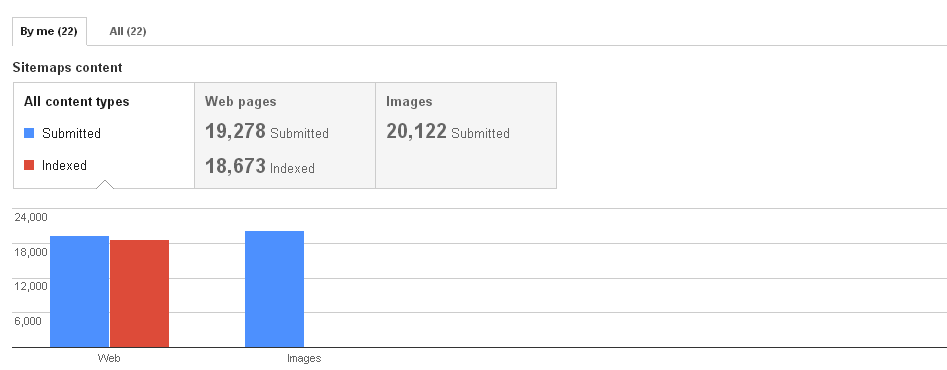 Can you please help me, why my images are not indexing in google yet? is there any issue? please give me suggestions?Thanks!
0
Can you please help me, why my images are not indexing in google yet? is there any issue? please give me suggestions?Thanks!
0 -

Adding multi-language sitemaps to robots.txt
I am working on a revamped multi-language site that has moved to Magento. Each language runs off the core coding so there are no sub-directories per language. The developer has created sitemaps which have been uploaded to their respective GWT accounts. They have placed the sitemaps in new directories such as: /sitemap/uk/sitemap.xml /sitemap/de/sitemap.xml I want to add the sitemaps to the robots.txt but can't figure out how to do it. Also should they have placed the sitemaps in a single location with the file identifying each language: /sitemap/uk-sitemap.xml /sitemap/de-sitemap.xml What is the cleanest way of handling these sitemaps and can/should I get them on robots.txt?
Technical SEO | | MickEdwards0 -

Removing robots.txt on WordPress site problem
Hi..am a little confused since I ticked the box in WordPress to allow search engines to now crawl my site (previously asked for them not to) but Google webmaster tools is telling me I still have robots.txt blocking them so am unable to submit the sitemap. Checked source code and the robots instruction has gone so a little lost. Any ideas please?
Technical SEO | | Wallander0 -

Hreflang on non-canonical pages
Hi! I've been trying to figure out what is the best way to solve this dilemma with duplicate content and multiple languages across domains. 1 product info page 2 same product but GREEN
Technical SEO | | LarsEriksson
3 same product but RED
4 same product but YELLOW **Question: ** Since pages 2,3,4 just varies slightly I use the canonical tag to indicate they are duplicates of page 1. Now I also want to indicate there are other language versions with the_ rel="alternate" hreflang="x" _element. Should I place the _rel="alternate" hreflang="x" _on the canonical page only pointing to the canonical page with "x" language. Should I place the _rel="alternate" hreflang="x" _on all pages pointing to the canonical page with the "x" language? Should I place the _rel="alternate" hreflang="x" _on all pages and then point it to the translated page (even if it is not a canonical page) ? /Lars0 -
OK to block /js/ folder using robots.txt?
I know Matt Cutts suggestions we allow bots to crawl css and javascript folders (http://www.youtube.com/watch?v=PNEipHjsEPU) But what if you have lots and lots of JS and you dont want to waste precious crawl resources? Also, as we update and improve the javascript on our site, we iterate the version number ?v=1.1... 1.2... 1.3... etc. And the legacy versions show up in Google Webmaster Tools as 404s. For example: http://www.discoverafrica.com/js/global_functions.js?v=1.1
Technical SEO | | AndreVanKets
http://www.discoverafrica.com/js/jquery.cookie.js?v=1.1
http://www.discoverafrica.com/js/global.js?v=1.2
http://www.discoverafrica.com/js/jquery.validate.min.js?v=1.1
http://www.discoverafrica.com/js/json2.js?v=1.1 Wouldn't it just be easier to prevent Googlebot from crawling the js folder altogether? Isn't that what robots.txt was made for? Just to be clear - we are NOT doing any sneaky redirects or other dodgy javascript hacks. We're just trying to power our content and UX elegantly with javascript. What do you guys say: Obey Matt? Or run the javascript gauntlet?0

