Moz Q&A is closed.
After more than 13 years, and tens of thousands of questions, Moz Q&A closed on 12th December 2024. Whilst we’re not completely removing the content - many posts will still be possible to view - we have locked both new posts and new replies. More details here.
What's the difference between a category page and a content page
-
Hello,
Little confused on this matter.
From a website architectural and content stand point, what is the difference between a category page and a content page?
So lets say I was going to build a website around tea.
My home page would be about tea.
My category pages would be:
White Tea, Black Tea, Oolong Team and British Tea correct? ( I Would write content for each of these topics on their respective category pages correct?)
Then suppose I wrote articles on organic white tea, white tea recipes, how to brew white team etc...( Are these content pages?)
Do I think link FROM my category page ( White Tea) to my ( Content pages ie; Organic White Tea, white tea receipes etc) or do I link from my content page to my category page?
I hope this makes sense.
Thanks,
Bill
-
Ryan,
You added some great additional insight here for Bill to consider. Excellent work on that.
And yes, I agree with you in not being happy that the "edit" link doesn't want to work lately here.
-
and let me say how much I dislike how the Edit button is presently broken. Grrrrrrr
-
I like Alan's answer. A couple direct answers to questions you raised:
From a website architecture stand point, there is no difference between a category page and a content page. They are both web pages and it's up to you, as the site owner, to determine how they can be utilized to best present your product.
From a content stand point, there is no right or wrong answer, but there are best practices. On the one end, some site owners use category pages purely as an organizational tool. Let's say you find a site about "beverages". There could be a categories for Coffee, Tea and Juice. There are three ways you can use the Tea page:
1. Content Separator. The Tea category would only be viewable from a main index page which allows visitors to see how your content is organized. The category page would not be reachable per se. "Tea" would be text, not a hyperlink. I think this usage is a missed opportunity from a web design perspective.
2. Content Index. The Tea category would be used to provide links to all the Tea pages. Some websites would choose to simply add links to their various tea pages. Other sites choose to offer high level information about each tea, along with the link. The latter choice works pretty well.
3. Content. You can use your category page to provide content. When I look up [url=http://en.wikipedia.org/wiki/Tea]Wikipedia's Tea page[/url] there is a lot of information which can all be included on your Tea page.
It really depends on the balance you wish to achieve for your site. What is the focus? Is "Tea" something you want to sell or educate your visitors about? Or is "Tea" a road marker used to guide readers to the real destination.
You asked "Do I link FROM my category page to my content pages or do I link from my content page to my category page".
My answer would be, both. Let's say "Bill's Black Tea" was one of your products. On your Black Tea category page, you would use anchor text to link to Bill's Black Tea. You might say "If you want a smooth tasting tea, try Bill's Black Tea". Your anchor text would be "Bill's Black Tea" which would link to that page.
From the Bill's Black Tea page, you may make a general statement such as "Connoisseurs of black tea will appreciate the smooth taste of Bill's Black Tea" with "black tea" being anchor text back to the category page.
You asked a great question. The answer requires some high level thinking on your part. Do you want your site to be an educational resource for visitors, and your site happens to also sell tea? Or are you a tea merchant who offers high level information about the products you offer?
There is not a right or wrong answer. It's market positioning.
-
It's easy to get confused with terminology. All pages, however, should have high quality, unique, paragraph based content, no matter what you call them.
You have the right idea for organization.
From the home page, there should be links to the top level categories
White Tea
Black Tea
Oolong Tea
British Tea
Then all of your articles having anything to do with White Tea would be linked from within the White Tea section of the site.
So the tree would then look like:
- White Tea
- Organic White Tea
- White Tea Recipes
- How to Brew White Tea
- Black Tea
- Oolong Tea
- British Tea
This is, in fact, high quality content organization. So congratulations for having understood the concept.
- White Tea



Got a burning SEO question?
Subscribe to Moz Pro to gain full access to Q&A, answer questions, and ask your own.
Browse Questions
Explore more categories
-
Moz Tools
Chat with the community about the Moz tools.
-
SEO Tactics
Discuss the SEO process with fellow marketers
-
Community
Discuss industry events, jobs, and news!
-
Digital Marketing
Chat about tactics outside of SEO
-
Research & Trends
Dive into research and trends in the search industry.
-
Support
Connect on product support and feature requests.
Related Questions
-

Duplicate content, although page has "noindex"
Hello, I had an issue with some pages being listed as duplicate content in my weekly Moz report. I've since discussed it with my web dev team and we decided to stop the pages from being crawled. The web dev team added this coding to the pages <meta name='robots' content='max-image-preview:large, noindex dofollow' />, but the Moz report is still reporting the pages as duplicate content. Note from the developer "So as far as I can see we've added robots to prevent the issue but maybe there is some subtle change that's needed here. You could check in Google Search Console to see how its seeing this content or you could ask Moz why they are still reporting this and see if we've missed something?" Any help much appreciated!
Technical SEO | | rj_dale0 -

Spam URL'S in search results
We built a new website for a client. When I do 'site:clientswebsite.com' in Google it shows some of the real, recently submitted pages. But it also shows many pages of spam url results, like this 'clientswebsite.com/gockumamaso/22753.htm' - all of which then go to the sites 404 page. They have page titles and meta descriptions in Chinese or Japanese too. Some of the urls are of real pages, and link to the correct page, despite having the same Chinese page titles and descriptions in the SERPS. When I went to remove all the spammy urls in Search Console (it only allowed me to temporarily hide them), a whole load of new ones popped up in the SERPS after a day or two. The site files itself are all fine, with no errors in the server logs. All the usual stuff...robots.txt, sitemap etc seems ok and the proper pages have all been requested for indexing and are slowly appearing. The spammy ones continue though. What is going on and how can I fix it?
Technical SEO | | Digital-Murph0 -

Strange URL's for client's site
We just picked up a new client and I've been doing some digging around on their site. They have quite the wide variety of URL's that make for a rather confusing experience. One of the milder examples is their "About" page. Normally I would expect something along the lines of: www.website.com/about I see: www.website.com/default.asp?Page=About I'm typically a graphic designer and know basically nothing about code, but I just assume this has something funky to do with how their website was constructed. I'm assuming this isn't particularly SEO friendly, but it doesn't seem too bad. Until I got to another section of their site. It's a section that logically should look like: www.website.com/training/public-seminars It's: www.website.com/default.asp?Page=MT&Area=Seminars&Sub=MRM Now that's nonsensical to me! Normally if a client has terrible URL's, I'd say let's do some redirects, but I guess I'm a little intimidated by these. Do the URL's have to be structured like this for some reason? Am I missing some important area of coding here? However, the most bizarre example is a link back to their website from yellowpages.com. Where normally I would expect it to lead to their homepage, I get this bizarre-looking thing: http://website1-px.rtrk.com/?utm_source=ReachLocal&utm_medium=PPC&utm_campaign=AssetManagement&reference_id=15&publisher=yellowpages&placement=ypwebsitemip&action_target=listing_website And as you browse through the site, that strange domain stays. For example the About page is now: http://website1-px.rtrk.com/default.asp?Page=About I would try to google this but I have no idea where to even start! What is going on with these links? Will we be able to fix them to something presentable without breaking their website?
Technical SEO | | everestagency0 -

Does Title Tag location in a page's source code matter?
Currently our meta description is on line 8 for our page - http://www.paintball-online.com/Paintball-Guns-And-Markers-0Y.aspx
Technical SEO | | Istoresinc The title tag, however sits below a bunch of code on line 237
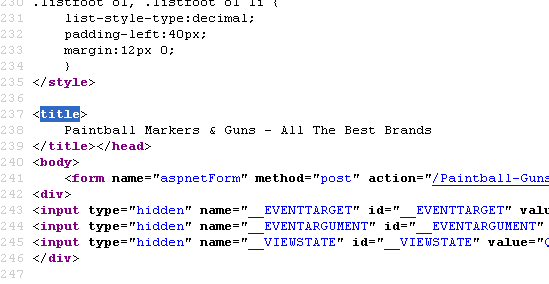 Does the location of the title tag, meta tags, and any structured data have any influence with respect to SEO and search engines? Put another way, could we benefit from moving the title tag up to the top?
I "surfed 'n surfed" and could not find any articles about this.
I would really appreciate any help on this as our site got decimated organically last May and we are looking for any help with SEO.
NIck
0
Does the location of the title tag, meta tags, and any structured data have any influence with respect to SEO and search engines? Put another way, could we benefit from moving the title tag up to the top?
I "surfed 'n surfed" and could not find any articles about this.
I would really appreciate any help on this as our site got decimated organically last May and we are looking for any help with SEO.
NIck
0 -

We have set up 301 redirects for pages from an old domain, but they aren't working and we are having duplicate content problems - Can you help?
We have several old domains. One is http://www.ccisound.com - Our "real" site is http://www.ccisolutions.com The 301 redirect from the old domain to the new domain works. However, the 301-redirects for interior pages, like: http://www.ccisolund.com/StoreFront/category/cd-duplicators do not work. This URL should redirect to http://www.ccisolutions.com/StoreFront/category/cd-duplicators but as you can see it does not. Our IT director supplied me with this code from the HT Access file in hopes that someone can help point us in the right direction and suggest how we might fix the problem: RewriteCond%{HTTP_HOST} ccisound.com$ [NC] RewriteRule^(.*)$ http://www.ccisolutions.com/$1 [R=301,L] Any ideas on why the 301 redirect isn't happening? Thanks all!
Technical SEO | | danatanseo0 -

Can I format my H1 to be smaller than H2's and H3's on the same page?
I would like to create a web design with 12px H1 and for sub headings on the page to be more like 24px. Will search engines see this and dislike it? The reason for doing it is that I want to put a generic page title in the banner, and more poetic headings above the main body. Example: Small H1: Wholesale coffee, online coffee shop and London roastery Large h2: Respect the bean... Thanks
Technical SEO | | Crumpled_Dog
Scott0 -

Blank pages in Google's webcache
Hello all, Is anybody experiencing blanck page's in Google's 'Cached' view? I'm seeing just the page background and none of the content for a couple of my pages but when I click 'View Text Only' all of teh content is there. Strange! I'd love to hear if anyone else is experiencing the same. Perhaps this is something to do with the roll out of Google's updates last week?! Thanks,
Technical SEO | | A_Q
Elias0 -

Does 'framing' a website create duplicate content?
Something I have not come across before, but hope others here are able offer advice based on experience: A client has independently created a series of mini-sites, aimed at targeting specific locations. The tactic has worked very well and they have achieved a large amount of well targeted traffic as a result. Each mini-site is different but then in the nav, if you want to view prices or go to the booking page, that then links to what at first appears to be their main site. However, you then notice that the URL is actually situated on the mini-site. What they have done is 'framed' the main site so that it appears exactly the same even when navigating through this exact replica site. Checking the code, there is almost nothing there - in fact there is actually no content at all. Below the head, there is a piece of code: <frameset rows="*" framespacing=0 frameborder=0> <frame src="[http://www.example.com](view-source:http://www.yellowskips.com/)" frameborder=0 marginwidth=0 marginheight=0> <noframes>Your browser does not support frames. Click [here](http://www.example.com) to view.noframes> frameset> Given that main site content does not appear to show in the source code, do we have an issue with duplicate content? This issue is that these 'referrals' are showing in Analytics, despite the fact that the code does not appear in the source, which is slightly confusing for me. They have done this without consultation and I'm very concerned that this could potentially be creating duplicate content of their ENTIRE main site on dozens of mini-sites. I should also add that there are no links to the mini-sites from the main site, so if you guys advise that this is creating duplicate content, I would not be worried about creating a link-wheel if I advise them to link directly to the main site rather than the framed pages. Thanks!
Technical SEO | | RiceMedia0