Moz Q&A is closed.
After more than 13 years, and tens of thousands of questions, Moz Q&A closed on 12th December 2024. Whilst we’re not completely removing the content - many posts will still be possible to view - we have locked both new posts and new replies. More details here.
Putting nav code at the bottom of a page?
-
Hey,
We are doing a re-design on our websites and we have run into a little problem.
Basically we need to put the nav code at the bottom of the page (so when you view source all the nav code it at the bottom) but the nav will of course still show at the top.
Will this cause any issues with our SEO? Will it make the nav seem less important or get crawled less?
Thanks for the help in advance!
Ricky
-
I have placed the nav code at the bottom of the HTML doc at times. I can't really say that it is a significant difference for SEO. It doesn't take a lot of work to do if you are skilled with HTML/CSS but I can't really say that this methodology will have a long term benefit for SEO.
HTML 5 has new tags that sites should adopt such as
<nav>and other tags to indicate what that chunk of content is. These tags are supported by all major browsers at this point. I don't know all the specific browser versions. I would recommend this moving forward where possible. By using this tags the crawlers likely will not factor in position in the document to understand the importance of chunks of content.</nav>
-
I see the value of associating anchor text with content links rather than navigation, but I agree with EGOL more than Ryan on this one. What if users are viewing the site with CSS disabled? Maybe because it's easier to view with a screen reader for blind/partially sighted people - it's not very user-friendly having the main navigation links only at the bottom is it?
-
I think that google is smart enough to tell nav code from content.
Most people who do this are probably wasting their time.
I put the nav code at the top... it contains some of my most important links.
Think about it.... If you think that Google can't identify nav code then this is like putting the links to your most important category pages in the footer. Do you really want to do that?
-
Hi Ricky, how big is this site... I have done this 3 years ago on a site I manage of about 100 pages. It worked fine from the first day. My main drive for this though was: I had one horizontal nav on top with no value links which the client insisted in having plus the beefy left hand vertical nav with the right keywords in. In the code I displaced the top horizontal nav to the bottom as and kept the left hand side vertical navigation on the top (codewise). It works wonderfully and no issues with Google at all.
cheers
david
-
Placing the navigation code at the bottom of your HTML is preferable from a SEO perspective.
I have never heard of any system that "had" to place the nav code at the bottom. I've always had to specifically request the nav code be moved to the bottom of the page. I am curious. What software are you working with that requires the code placed at the bottom?
Presently crawlers read your site's HTML code from top to bottom. By placing your nav code at the bottom you can associate anchor text with your content links rather then your navigation links, which is generally preferable. This reasoning is why I position the nav code at the bottom of the html code.
In the future that may change with HTML and other semantic markup offering the ability for crawlers to easily identify content, but for now your approach is preferable in my experience.






Got a burning SEO question?
Subscribe to Moz Pro to gain full access to Q&A, answer questions, and ask your own.
Browse Questions
Explore more categories
-
Moz Tools
Chat with the community about the Moz tools.
-
SEO Tactics
Discuss the SEO process with fellow marketers
-
Community
Discuss industry events, jobs, and news!
-
Digital Marketing
Chat about tactics outside of SEO
-
Research & Trends
Dive into research and trends in the search industry.
-
Support
Connect on product support and feature requests.
Related Questions
-

Rel=Canonical For Landing Pages
We have PPC landing pages that are also ranking in organic search. We've decided to create new landing pages that have been improved to rank better in natural search. The PPC team however wants to use their original landing pages so we are unable to 301 these pages to the new pages being created. We need to block the old PPC pages from search. Any idea if we can use rel=canonical? The difference between old PPC page and new landing page is much more content to support keyword targeting and provide value to users. Google says it's OK to use rel=canonical if pages are similar but not sure if this applies to us. The old PPC pages have 1 paragraph of content followed by featured products for sale. The new pages have 4-5 paragraphs of content and many more products for sale. The other option would be to add meta noindex to the old PPC landing pages. Curious as to what you guys think. Thanks.
Technical SEO | | SoulSurfer80 -

Indexed pages
Just started a site audit and trying to determine the number of pages on a client site and whether there are more pages being indexed than actually exist. I've used four tools and got four very different answers... Google Search Console: 237 indexed pages Google search using site command: 468 results MOZ site crawl: 1013 unique URLs Screaming Frog: 183 page titles, 187 URIs (note this is a free licence, but should cut off at 500) Can anyone shed any light on why they differ so much? And where lies the truth?
Technical SEO | | muzzmoz1 -

Does Title Tag location in a page's source code matter?
Currently our meta description is on line 8 for our page - http://www.paintball-online.com/Paintball-Guns-And-Markers-0Y.aspx
Technical SEO | | Istoresinc The title tag, however sits below a bunch of code on line 237
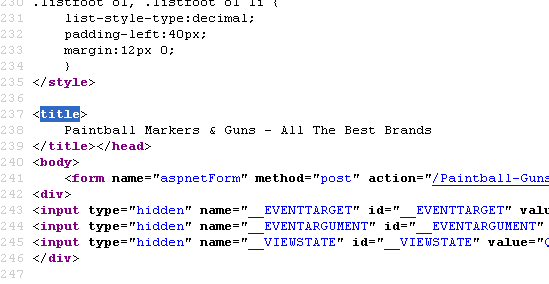 Does the location of the title tag, meta tags, and any structured data have any influence with respect to SEO and search engines? Put another way, could we benefit from moving the title tag up to the top?
I "surfed 'n surfed" and could not find any articles about this.
I would really appreciate any help on this as our site got decimated organically last May and we are looking for any help with SEO.
NIck
0
Does the location of the title tag, meta tags, and any structured data have any influence with respect to SEO and search engines? Put another way, could we benefit from moving the title tag up to the top?
I "surfed 'n surfed" and could not find any articles about this.
I would really appreciate any help on this as our site got decimated organically last May and we are looking for any help with SEO.
NIck
0 -

No_index of parent page
Hi, sorry its a Friday question... Page A: www.example.com/house/ Page B: www.example.com/house/kitchen Can I 'no_index' page A without it effecting page B being indexed? Views? Many thanks!
Technical SEO | | Richard5551 -
Where to put Schema On Page
What part of my page should I put Schema data? Header? Footer? Also All pages? or just home page?
Technical SEO | | bozzie3114 -

Do web pages have to be linked to a menu?
I have a situation where people search for terms like, say 1978 one dollar bill. Even though there never was a 1978 one dollar bill. I want to make a page to capture these searches but since there wasn't such a thing as a one dollar bill I don't want it connected to the rest of my content which is reality based. Does that make sense? Anyway, my question is, can I publish pages that aren't linked to my menu structure but that will be searchable or, am I going to have to figure out a way to make these oddball pages accessible through my menu?
Technical SEO | | Banknotes0 -

Handling 301s: Multiple pages to a single page (consolidation)
Been scouring the interwebs and haven't found much information on redirecting two serparate pages to a single new page. Here is what it boils down to: Let's say a website has two pages, both with good page authority of products that are becoming fazed out. The products, Widget A and Widget B, are still popular search terms, but they are being combined into ONE product, Widget C. While Widget A and Widget B STILL have plenty to do with Widget C, Widget C is now the new page, the main focus page, and the page you want everyone to see and Google to recognize. Now, do I 301 Widget A and Widget B pages to Widget C, ALTHOUGH Widgets A and B previously had nothing to do with one another? (Remember, we want to try and keep some of that authority the two page have had.) OR do we keep Widget A and Widget B pages "alive", take them off the main navigation, and then put a "disclaimer" on the pages announcing they are now part of Widget C and link to Widget C? OR Should Widgets A and B page be canonicalized to Widget C? Again, keep in mind, widgets A and B previously were not similar, but NOW they are and result in Widget C. (If you are confused, we can provide a REAL work example of what we are talkinga about, but decided to not be specific to our industry for this.) Appreciate any and all thoughts on this.
Technical SEO | | JU19850

