Moz Q&A is closed.
After more than 13 years, and tens of thousands of questions, Moz Q&A closed on 12th December 2024. Whilst we’re not completely removing the content - many posts will still be possible to view - we have locked both new posts and new replies. More details here.
Unsolved Capturing Source Dynamically for UTM Parameters
-
Does anyone have a tutorial on how to dynamically capture the referring source to be populated in UTM parameters for Google Analytics?
We want to syndicate content and be able to see all of the websites that provided referral traffic for this specific objective. We want to set a specific utm_medium and utm_campaign but have the utm_source be dynamic and capture the referring website.
If we set a permanent utm_source, it would appear the same for all incoming traffic.
Thanks in advance!
-
@peteboyd said in Capturing Source Dynamically for UTM Parameters:
Thanks in advance!
UTM (Urchin Tracking Module) parameters are tags that you can add to the end of a URL in order to track the effectiveness of your marketing campaigns. These parameters are used by Google Analytics to help you understand how users are interacting with your website and where they are coming from.
There are five different UTM parameters that you can use:
utm_source: This parameter specifies the source of the traffic, such as "google" or "Facebook".
utm_medium: This parameter specifies the medium of the traffic, such as "cpc" (cost-per-click) or "social".
utm_campaign: This parameter specifies the name of the campaign, such as "spring_sale" or "promotion".
utm_term: This parameter specifies the term or keywords used in the campaign, such as "shoes" or "dress".
utm_content: This parameter specifies the content of the ad, such as the headline or the call-to-action.
To capture the source dynamically for UTM parameters, you can use JavaScript to get the value of the document. referrer property. This property returns the URL of the page that is linked to the current page. You can then use this value to set the utm_source parameter dynamically.
For example, you might use the following code to set the utm_source parameter based on the referring URL:
Copy code
var utmSource = '';if (document.referrer.indexOf('google') !== -1) {
utmSource = 'google';
} else if (document.referrer.indexOf('facebook') !== -1) {
utmSource = 'facebook';
}// Add the utm_source parameter to the URL
var url = 'http://www.example.com?utm_source=' + utmSource;
This code will set the utm_source parameter to "google" if the user came to the page from a Google search or to "Facebook" if the user came to the page from Facebook. If the user came to the page from another source, the utm_source parameter will be left empty.You can then use this modified URL in your marketing campaigns to track the effectiveness of your campaigns and understand where your traffic is coming from.
-
@peteboyd you can refer to this tutorial: https://www.growwithom.com/2020/06/16/track-dynamic-traffic-google-tag-manager/
Should meet your requirements perfectly - using GTM to replace a static value with the url in your UTM Source.



Got a burning SEO question?
Subscribe to Moz Pro to gain full access to Q&A, answer questions, and ask your own.
Browse Questions
Explore more categories
-
Moz Tools
Chat with the community about the Moz tools.
-
SEO Tactics
Discuss the SEO process with fellow marketers
-
Community
Discuss industry events, jobs, and news!
-
Digital Marketing
Chat about tactics outside of SEO
-
Research & Trends
Dive into research and trends in the search industry.
-
Support
Connect on product support and feature requests.
Related Questions
-

Unsolved Question about a Screaming Frog crawling issue
Hello, I have a very peculiar question about an issue I'm having when working on a website. It's a WordPress site and I'm using a generic plug in for title and meta updates. When I go to crawl the site through screaming frog, however, there seems to be a hard coded title tag that I can't find anywhere and the plug in updates don't get crawled. If anyone has any suggestions, thatd be great. Thanks!
Technical SEO | | KyleSennikoff0 -

Need some help understanding SEO - Please help before I lose [pull out] all my hair
I'm new to SEO, and am stubbornly trying to educate myself. I have a telescope shop in Canada, it's a small business that we run on the side. We're driving lots of traffic through FB and our outreach programs but I really want to increase our presence on search. We released a new website back in January and it killed some of our rankings. We're working our way back with a very specific set of efforts on regular SEO: Metadata and titles, although it seems that's not super relevant Building high quality backlinks and eliminating any spammy backlinks Rewriting product listings so that they are original content though I'm not sure how important this is in e-commerce Writing high quality articles and blog posts Working relevant keywords into our product pages and titles I understand that good SEO is about pushing on all the levers, and trying to make sure that your site is as valuable to the end user as possible. We're making some good progress, but I'm puzzled by the #1 shop in Canada. They don't put any apparent effort into SEO and they still rank #1 on every key product we compete with them on. I've worked with two separate, highly ranked and regarded SEO firms on this and neither has been able to tell my why this other site ranks so highly. Here's a specific example on a popular product that we both sell, the Celestron NexStar 8SE. Here’s the link to Telescope Canada’s page for their Celestron 8SE: https://telescopescanada.ca/products/celestron-nexstar-8se-computerized-telescope-11069 Here’s a link to the Celestron 8SE page from the manufacturer website: https://www.celestron.com/products/nexstar-8se-computerized-telescope Telescopes Canada has just copied and pasted. There is no original content aside from adding the shipping and return policy to the tab, and having some options for selecting accessories on the page. Here is our page: https://all-startelescope.com/products/celestron-nexstar-8se We have higher page authority, higher domain authority, and they keyword analyzer in moz says that our page is higher quality than the Telescopes Canada page. I can’t find a single metric on any tool (ubbersuggest, Moz, ahrefs, semrush) that says Telescopes Canada is a better site, or has a better NexStar 8SE product page. But they keep ranking ahead of us, and right at the top of google search. Our titles are good, our metadata is good (but I don’t think that’s been a serious ranking factor for about ten years). Our text is original, it’s relevant, we have healthy internal links to the page. According to Moz's page ranker it's 20 points higher than Telescope Canada's page. We have invensted in some excellent blog content, we’re adding new products to the website so that we rank for more keywords. All of those things are helping, but I fundamentally don’t understand why Telescopes Canada is #1 almost across the board on every key product in our market. There is something that I’m not seeing here. Can you see any metric, any tool in your toolbox that indicates why they rank at the top, or even higher than we do for in these search terms specific to that product: Celestron NexStar 8SE
Intermediate & Advanced SEO | | nkennett
NexStar 8SE
Celestron NexStar 8SE Canada
NexStar 8SE Canada I have a feeling it's something technical that I'm missing, but I'm not sure how obvious it is with two 'professional' firms not finding it. I'd really appreciate any help or insight that you can offer.0 -

Dynamically Inserting Noindex With Javascript
Hello, I have a broken plugin creating hundreds of WP-Content directory pages being indexed by Google. I can not access the source code of these pages to add a noindex to them. The page URL's all have the plugin name within them. In order to resolve the issue, I wrote a solution with javascript to dynamically add in a noindex tag to any URL containing the plugin name. Would this noindex be respected by Google and is there a way to immediately check that it is respected? Currently, I can not delete the plugin due to issues with it's php. If you would like to view the code: https://codepen.io/trodrick/pen/Gwwaej?editors=0010 Thanks!
Technical SEO | | Tom3_150 -

Indexing Issue of Dynamic Pages
Hi All, I have a query for which i am struggling to find out the answer. I unable to retrieve URL using "site:" query on Google SERP. However, when i enter the direct URL or with "info:" query then a snippet appears. I am not able to understand why google is not showing URL with "site:" query. Whether the page is indexed or not? Or it's soon going to be deindexed. Secondly, I would like to mention that this is a dynamic URL. The index file which we are using to generate this URL is not available to Google Bot. For instance, There are two different URL's. http://www.abc.com/browse/ --- It's a parent page.
Technical SEO | | SameerBhatia
http://www.abc.com/browse/?q=123 --- This is the URL, generated at run time using browse index file. Google unable to crawl index file of browse page as it is unable to run independently until some value will get passed in the parameter and is not indexed by Google. Earlier the dynamic URL's were indexed and was showing up in Google for "site:" query but now it is not showing up. Can anyone help me what is happening here? Please advise. Thanks0 -

Does Title Tag location in a page's source code matter?
Currently our meta description is on line 8 for our page - http://www.paintball-online.com/Paintball-Guns-And-Markers-0Y.aspx
Technical SEO | | Istoresinc The title tag, however sits below a bunch of code on line 237
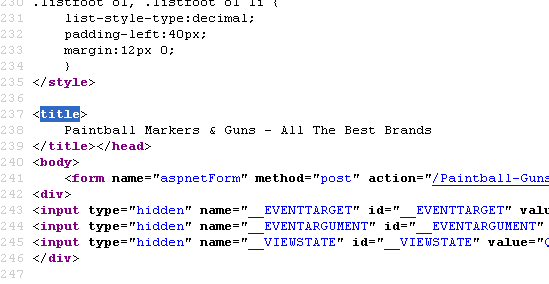 Does the location of the title tag, meta tags, and any structured data have any influence with respect to SEO and search engines? Put another way, could we benefit from moving the title tag up to the top?
I "surfed 'n surfed" and could not find any articles about this.
I would really appreciate any help on this as our site got decimated organically last May and we are looking for any help with SEO.
NIck
0
Does the location of the title tag, meta tags, and any structured data have any influence with respect to SEO and search engines? Put another way, could we benefit from moving the title tag up to the top?
I "surfed 'n surfed" and could not find any articles about this.
I would really appreciate any help on this as our site got decimated organically last May and we are looking for any help with SEO.
NIck
0 -

Best Practices for adding Dynamic URL's to XML Sitemap
Hi Guys, I'm working on an ecommerce website with all the product pages using dynamic URL's (we also have a few static pages but there is no issue with them). The products are updated on the site every couple of hours (because we sell out or the special offer expires) and as a result I keep seeing heaps of 404 errors in Google Webmaster tools and am trying to avoid this (if possible). I have already created an XML sitemap for the static pages and am now looking at incorporating the dynamic product pages but am not sure what is the best approach. The URL structure for the products are as follows: http://www.xyz.com/products/product1-is-really-cool
Technical SEO | | seekjobs
http://www.xyz.com/products/product2-is-even-cooler
http://www.xyz.com/products/product3-is-the-coolest Here are 2 approaches I was considering: 1. To just include the dynamic product URLS within the same sitemap as the static URLs using just the following http://www.xyz.com/products/ - This is so spiders have access to the folder the products are in and I don't have to create an automated sitemap for all product OR 2. Create a separate automated sitemap that updates when ever a product is updated and include the change frequency to be hourly - This is so spiders always have as close to be up to date sitemap when they crawl the sitemap I look forward to hearing your thoughts, opinions, suggestions and/or previous experiences with this. Thanks heaps, LW0 -

Blocking URL's with specific parameters from Googlebot
Hi, I've discovered that Googlebot's are voting on products listed on our website and as a result are creating negative ratings by placing votes from 1 to 5 for every product. The voting function is handled using Javascript, as shown below, and the script prevents multiple votes so most products end up with a vote of 1, which translates to "poor". How do I go about using robots.txt to block a URL with specific parameters only? I'm worried that I might end up blocking the whole product listing, which would result in de-listing from Google and the loss of many highly ranked pages. DON'T want to block: http://www.mysite.com/product.php?productid=1234 WANT to block: http://www.mysite.com/product.php?mode=vote&productid=1234&vote=2 Javacript button code: onclick="javascript: document.voteform.submit();" Thanks in advance for any advice given. Regards,
Technical SEO | | aethereal
Asim0 -

Dynamically-generated .PDF files, instead of normal pages, indexed by and ranking in Google
Hi, I come across a tough problem. I am working on an online-store website which contains the functionlaity of viewing products details in .PDF format (by the way, the website is built on Joomla CMS), now when I search my site's name in Google, the SERP simply displays my .PDF files in the first couple positions (shown in normal .PDF files format: [PDF]...)and I cannot find the normal pages there on SERP #1 unless I search the full site domain in Google. I really don't want this! Would you please tell me how to figure the problem out and solve it. I can actually remove the corresponding component (Virtuemart) that are in charge of generating the .PDF files. Now I am trying to redirect all the .PDF pages ranking in Google to a 404 page and remove the functionality, I plan to regenerate a sitemap of my site and submit it to Google, will it be working for me? I really appreciate that if you could help solve this problem. Thanks very much. Sincerely SEOmoz Pro Member
Technical SEO | | fugu0