Moz Q&A is closed.
After more than 13 years, and tens of thousands of questions, Moz Q&A closed on 12th December 2024. Whilst we’re not completely removing the content - many posts will still be possible to view - we have locked both new posts and new replies. More details here.
Screaming From occurences and canonicals what does it all mean
-
Bonjourno from Wetherby UK...
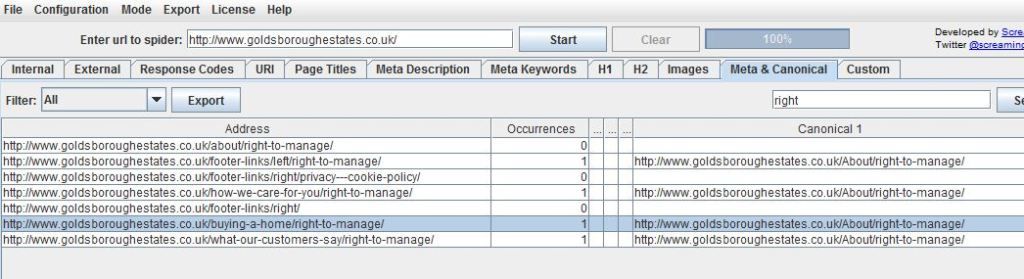
Ive used a package called screamong frog to diagnose canonical errors but can anyone tell me what this means? http://i216.photobucket.com/albums/cc53/zymurgy_bucket/understand-occurances-canonical.jpg
Thanks in advance.
David
-
Thank you for all your replies this was bugging me but the pain of not knowing has vanished like the morning mist as the warming glow of sunshine illumunates truth

-
David
Looks like you may have an issue there. The "address" and "canonical 1" should match about 99% of the time. Right now you're telling Google to index all those different address pages as a single URL (About/right-to-manage)... something to look at - and the suggestions below are both good as well.
-Dan
-
I agree with what Streamline Metrics said, I just want to add to this by linking you to a great SEOmoz post on canonicalization which may help you clear things up more.
In your case, having 1 rel="canonical" tag per page is what you want, so you should be fine with that, just make sure that the canonical tags (listed under canonical 1 in Screaming Frog) is the actual URL that you want.
Hope this helps
Zach -
It simply means how many canonical tags are found on that specific page. So if you had two rel=canonical tags on a page, it would say 2 occurrences. For more info, check out http://www.screamingfrog.co.uk/seo-spider/user-guide/tabs/





Got a burning SEO question?
Subscribe to Moz Pro to gain full access to Q&A, answer questions, and ask your own.
Browse Questions
Explore more categories
-
Moz Tools
Chat with the community about the Moz tools.
-
SEO Tactics
Discuss the SEO process with fellow marketers
-
Community
Discuss industry events, jobs, and news!
-
Digital Marketing
Chat about tactics outside of SEO
-
Research & Trends
Dive into research and trends in the search industry.
-
Support
Connect on product support and feature requests.
Related Questions
-

Do URLs with canonical tags get indexed by Google?
Hi, we re-branded and launched a new website in February 2016. In June we saw a steep drop in the number of URLs indexed, and there have continued to be smaller dips since. We started an account with Moz and found several thousand high priority crawl errors for duplicate pages and have since fixed those with canonical tags. However, we are still seeing the number of URLs indexed drop. Do URLs with canonical tags get indexed by Google? I can't seem to find a definitive answer on this. A good portion of our URLs have canonical tags because they are just events with different dates, but otherwise the content of the page is the same.
Technical SEO | | zasite0 -

Rel=canonical on Godaddy Website builder
Hey crew! First off this is a last resort asking this question here. Godaddy has not been able to help so I need my Moz Fam on this one. So common problem My crawl report is showing I have duplicate home pages www.answer2cancer.org and www.answer2cancer.org/home.html I understand this is a common issue with apache webservers which is why the wonderful rel=canonical tag was created! I don't want to go through the hassle of a 301 redirect of course for such a simple issue. Now here's the issue. Godaddy website builder does not make any sense to me. In wordpress I could just go add the tag to the head in the back end. But no such thing exist in godaddy. You have to do this weird drag and drop html block and drag it somewhere on the site and plug in the code. I think putting before the code instead of just putting it in there. So I did that but when I publish and inspect in chrome I cannot see the tag in the head! This is confusing I know. the guy at godaddy didn't stand a chance lol. Anyway much love for any replies!
Technical SEO | | Answer2cancer0 -

Magento Dublicate Content (Noindex and Rel"canonical")
Hi All, Just looking for some advice regarding my website on magento. We by mistake didnt enable canonical tags and noindex tags so had a big problem with dublicate content from filter pages but also have URLs to Cats as Yes so this didnt help with not having canonical tags enabled. We now have everything enabled for a few weeks now but dont see much drop in indexed pages in google. (currently 27k and we have only 5k products) My question basically is how do we speed up noindexation of dublicate content and also would you change URL to cats as No so google just now sees the url to products? (my concerns with this is would leaving it to Yes help because it will hopefully read the canonical tags on products now) Thank you in advance Michael
Technical SEO | | TogetherCare0 -

Two different canonical tags on one page
Due to an error, some of my pages now have two canonical tags on them. One is correct and the other goes to a nonsense URL (404 page). I know I should ideally remove the incorrect ones, but it's a big manual job. Are they doing any harm? Can I just leave them there and let Google figure it out? The correct ones are higher up in the code. Will this make a difference? Any help appreciated.
Technical SEO | | ShearingsGroup0 -

Hreflang on non-canonical pages
Hi! I've been trying to figure out what is the best way to solve this dilemma with duplicate content and multiple languages across domains. 1 product info page 2 same product but GREEN
Technical SEO | | LarsEriksson
3 same product but RED
4 same product but YELLOW **Question: ** Since pages 2,3,4 just varies slightly I use the canonical tag to indicate they are duplicates of page 1. Now I also want to indicate there are other language versions with the_ rel="alternate" hreflang="x" _element. Should I place the _rel="alternate" hreflang="x" _on the canonical page only pointing to the canonical page with "x" language. Should I place the _rel="alternate" hreflang="x" _on all pages pointing to the canonical page with the "x" language? Should I place the _rel="alternate" hreflang="x" _on all pages and then point it to the translated page (even if it is not a canonical page) ? /Lars0 -

How to structure rel=canonical for a e commerce site
Hello, So I have searched the Q & A , Google, the zen cart forum and at this point I am looking for some one to give a concrete answer on what I should do. There is a lot of different opinions on " rel=canonical" and how to apply it , since there are many other variable in place. I have a zen cart site. I am using the latest 1.3.9 version. The default setting ( seem to me) uses the rel=canonical to point back to the specific link product or category respectively. Most of the time I have two scenarios. 1. Main category ---> Sub category----> Product 2. Main Category----> Product I'll give an example http://www.perfectindesign.com/awards ---main category http://www.perfectindesign.com/awards/acrylic-awards sub category http://www.perfectindesign.com/awards/acrylic-awards/slanted-award product (this example has three sub categories with maybe 12 products in one 4 in the second and 5 in the third) From looking at the source code for each url it the rel=canonical just points back to its own url. I want to avoid competing against my self, for the example above keyword "acrylic awards" so should the use of the re=canonical be changes site wide to have products point back to sub categories when they exist and have products point back to main categories when no sub categories exist? I am very new to seo, specifically eCommerce seo. If you have experience and have done this to a site you manage for a client or your own please advise how to proceed. Also if I'm missing some thing that will give me a better understanding of the bigger seo picture that would be great. Thanks, Yevgeny
Technical SEO | | Yevgeny0 -

Trailing Slashes In Url use Canonical Url or 301 Redirect?
I was thinking of using 301 redirects for trailing slahes to no trailing slashes for my urls. EG: www.url.com/page1/ 301 redirect to www.url.com/page1 Already got a redirect for non-www to www already. Just wondering in my case would it be best to continue using htacces for the trailing slash redirect or just go with Canonical URLs?
Technical SEO | | upick-1623910 -

URL query strings and canonical tag
Hi, I have recently been getting my comparison website redesigned and developed onto wordpress and the site is now 90% complete. Part of the redesign has meant that there are now dynamic urls in the format: http://www.mywebsite.com/10-pounds-productss/?display=cost&value=10 I have other pages similar to this but with different content for the different price ranges and these are linked to from the menus: http://www.mywebsite.com/20-pounds-products/?display=cost&value=20 Now my questions are: 1. I am using Joost's All-in-one SEO plugin and this adds a canonical tag to the page that is pointing to http://www.mywebsite.com/10-pounds-products/ which is the permalink. Is this OK as it is or should i change this to http://www.mywebsite.com/10-pounds-products/?display=cost&value=10 2. Which URL will get indexed, what gets shown as the display URL in the SERPs and what page will users land on? I'm a bit confused so apologies if these seem like silly questions. Thanks
Technical SEO | | bizarro10000