Moz Q&A is closed.
After more than 13 years, and tens of thousands of questions, Moz Q&A closed on 12th December 2024. Whilst we’re not completely removing the content - many posts will still be possible to view - we have locked both new posts and new replies. More details here.
Screaming From occurences and canonicals what does it all mean
-
Bonjourno from Wetherby UK...
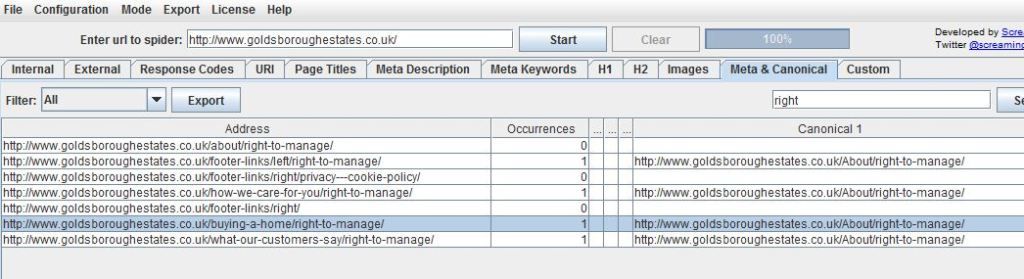
Ive used a package called screamong frog to diagnose canonical errors but can anyone tell me what this means? http://i216.photobucket.com/albums/cc53/zymurgy_bucket/understand-occurances-canonical.jpg
Thanks in advance.
David
-
Thank you for all your replies this was bugging me but the pain of not knowing has vanished like the morning mist as the warming glow of sunshine illumunates truth

-
David
Looks like you may have an issue there. The "address" and "canonical 1" should match about 99% of the time. Right now you're telling Google to index all those different address pages as a single URL (About/right-to-manage)... something to look at - and the suggestions below are both good as well.
-Dan
-
I agree with what Streamline Metrics said, I just want to add to this by linking you to a great SEOmoz post on canonicalization which may help you clear things up more.
In your case, having 1 rel="canonical" tag per page is what you want, so you should be fine with that, just make sure that the canonical tags (listed under canonical 1 in Screaming Frog) is the actual URL that you want.
Hope this helps
Zach -
It simply means how many canonical tags are found on that specific page. So if you had two rel=canonical tags on a page, it would say 2 occurrences. For more info, check out http://www.screamingfrog.co.uk/seo-spider/user-guide/tabs/





Got a burning SEO question?
Subscribe to Moz Pro to gain full access to Q&A, answer questions, and ask your own.
Browse Questions
Explore more categories
-
Moz Tools
Chat with the community about the Moz tools.
-
SEO Tactics
Discuss the SEO process with fellow marketers
-
Community
Discuss industry events, jobs, and news!
-
Digital Marketing
Chat about tactics outside of SEO
-
Research & Trends
Dive into research and trends in the search industry.
-
Support
Connect on product support and feature requests.
Related Questions
-

What could cause Google to not honor canonical URLs?
I have a strange situation on a website, when I do a Google query of site:example.com all the top indexed results appear to be queries that users can perform on the website. So any random term the user searches for on the website for some reason is causing the search result page to get indexed - like example.com/search/query/random-keywords However, the search results page has a canonical tag on it that points to example.com/search, but that doesn't seem to be doing anything. Any thoughts or ideas why this could be happening?
Technical SEO | | IrvCo_Interactive0 -

Does using a canonical with ?utm_source=gmb cause any issues?
All of our URLs in Google My Business are tagged with ?utm_source=gmb. This way when people click on it within a Google Map listing, knowledge graph, etc we know it came from there. I'm assuming using a canonical on all ?_utm_source _pages (we have others, including some in the index) won't cause any problems with this, correct? Since they're not technically traditional organic SERPs? Dumb question I know, but better safe than sorry. Thanks.
Technical SEO | | Alces1 -

Removing a canonical tag from Pagination pages
Hello, Currently on our site we have the rel=prev/next markup for pagination along with a self pointing canonical via the Yoast Plugin. However, on page 2 of our paginated series, (there's only 2 pages currently), the canonical points to page one, rather than page 2. My understanding is that if you use a canonical on paginated pages it should point to a viewall page as opposed to page one. I also believe that you don't need to use both a canonical and the rel=prev/next markup, one or the other will do. As we use the markup I wanted to get rid of the canonical, would this be correct? For those who use the Yoast Plugin have you managed to get that to work? Thanks!
Technical SEO | | jessicarcf0 -

Canonical for duplicate pages in ecommerce site and the product out of stock
I’m an SEO for an ecommerce site that sells shoes I have duplicate pages for different colors of the same product (unique URL for each color), Conventionally I have added canonical tags for each page, which direct to a specific product URL My question is what happens when a product which the googlbot is direct to, is out of stock but is still listed in the canonical tag ?
Technical SEO | | shoesonline0 -

Rel=canonical on Godaddy Website builder
Hey crew! First off this is a last resort asking this question here. Godaddy has not been able to help so I need my Moz Fam on this one. So common problem My crawl report is showing I have duplicate home pages www.answer2cancer.org and www.answer2cancer.org/home.html I understand this is a common issue with apache webservers which is why the wonderful rel=canonical tag was created! I don't want to go through the hassle of a 301 redirect of course for such a simple issue. Now here's the issue. Godaddy website builder does not make any sense to me. In wordpress I could just go add the tag to the head in the back end. But no such thing exist in godaddy. You have to do this weird drag and drop html block and drag it somewhere on the site and plug in the code. I think putting before the code instead of just putting it in there. So I did that but when I publish and inspect in chrome I cannot see the tag in the head! This is confusing I know. the guy at godaddy didn't stand a chance lol. Anyway much love for any replies!
Technical SEO | | Answer2cancer0 -

301 redirect: canonical or non canonical?
Hi, Newbie alert! I need to set up 301 redirects for changed URLs on a database driven site that is to be redeveloped shortly. The current site uses canonical header tags. The new site will also use canonical tags. Should the 301 redirects map the canonical URL on the old site to the corresponding canonical for the new design . . . or should they map the non canonical database URLs old and new? Given that the purpose of canonicals is to indicate our preferred URL, then my guess is that's what I should use. However, how can I be sure that Google (for example) has indexed the canonical in every case? Thx in anticipation.
Technical SEO | | ztalk1120 -

Robots.txt and canonical tag
In the SEOmoz post - http://www.seomoz.org/blog/robot-access-indexation-restriction-techniques-avoiding-conflicts, it's being said - If you have a robots.txt disallow in place for a page, the canonical tag will never be seen. Does it so happen that if a page is disallowed by robots.txt, spiders DO NOT read the html code ?
Technical SEO | | seoug_20050 -

Syndication: Link back vs. Rel Canonical
For content syndication, let's say I have the choice of (1) a link back or (2) a cross domain rel canonical to the original page, which one would you choose and why? (I'm trying to pick the best option to save dev time!) I'm also curious to know what would be the difference in SERPs between the link back & the canonical solution for the original publisher and for sydication partners? (I would prefer not having the syndication partners disappeared entirely from SERPs, I just want to make sure I'm first!) A side question: What's the difference in real life between the Google source attribution tag & the cross domain rel canonical tag? Thanks! PS: Don't know if it helps but note that we can syndicate 1 article to multiple syndication partners (It would't be impossible to see 1 article syndicated to 50 partners)
Technical SEO | | raywatson0