Moz Q&A is closed.
After more than 13 years, and tens of thousands of questions, Moz Q&A closed on 12th December 2024. Whilst we’re not completely removing the content - many posts will still be possible to view - we have locked both new posts and new replies. More details here.
How to index e-commerce marketplace product pages
-
Hello!
We are an online marketplace that submitted our sitemap through Google Search Console 2 weeks ago. Although the sitemap has been submitted successfully, out of ~10000 links (we have ~10000 product pages), we only have 25 that have been indexed.
I've attached images of the reasons given for not indexing the platform.
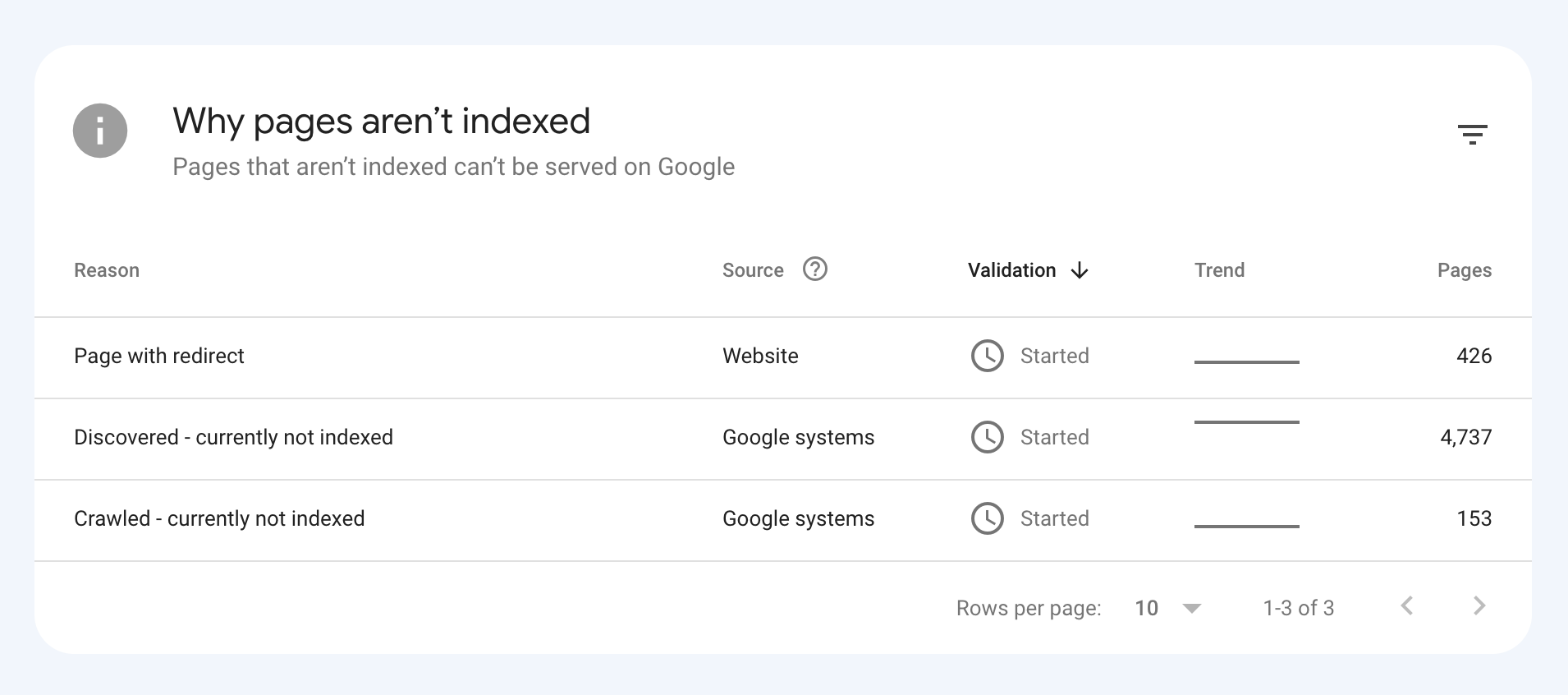
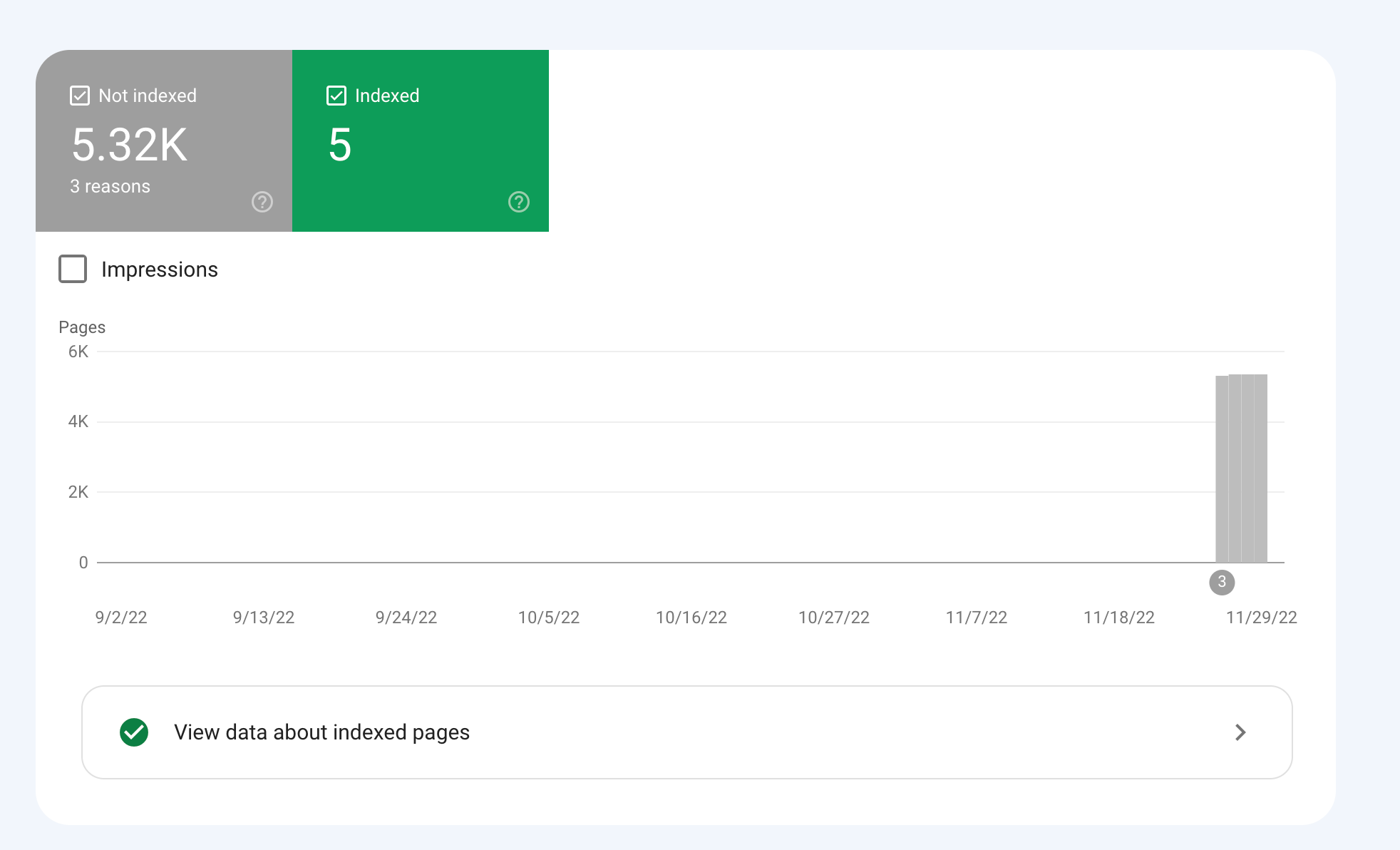
How would we go about fixing this?
-
To get your e-commerce marketplace product pages indexed, make sure your pages include unique and descriptive titles, meta descriptions, relevant keywords, and high-quality images. Additionally, optimize your URLs, leverage schema markup, and prioritize user experience for increased search engine visibility.
-
@fbcosta i hve this problem but its so less in my site
پوشاک پاپیون -
I'd appreciate if someone who faced the same indexing issue comes forward and share the case study with fellow members. Pin points steps a sufferer should do to overcome indexing dilemma. What actionable steps to do to enable quick product indexing? How we can get Google's attention so it can start indexing pages at a quick pace? Actionable advice please.
-
There could be several reasons why only 25 out of approximately 10,000 links have been indexed by Google, despite successfully submitting your sitemap through Google Search Console:
Timing: It is not uncommon for indexing to take some time, especially for larger sites with many pages. Although your sitemap has been submitted, it may take several days or even weeks for Google to crawl and index all of your pages. It's worth noting that not all pages on a site may be considered important or relevant enough to be indexed by Google.
Quality of Content: Google may not index pages that it considers low-quality, thin or duplicate content. If a significant number of your product pages have similar or duplicate content, they may not be indexed. To avoid this issue, make sure your product pages have unique, high-quality content that provides value to users.
Technical issues: Your site may have technical issues that are preventing Google from crawling and indexing your pages. These issues could include problems with your site's architecture, duplicate content, or other issues that may impact crawling and indexing.
Inaccurate Sitemap: There is also a possibility that there are errors in the sitemap you submitted to Google. Check the sitemap to ensure that all the URLs are valid, the sitemap is up to date and correctly formatted.
To troubleshoot this issue, you can check your site's coverage report on Google Search Console, which will show you which pages have been indexed and which ones haven't. You can also check your site's crawl report to see if there are any technical issues that may be preventing Google from crawling your pages. Finally, you can also run a site audit to identify and fix any technical issues that may be impacting indexing.
-
@fbcosta As per my experience, if your site is new it will take some time to index all of the URLs, and the second thing is, if you have Hundreds of URLs, it doesn't mean Google will index all of them.
You can try these steps which will help in fast indexing:
- Sharing on Social Media
- Interlinking from already indexed Pages
- Sitemap
- Share the link on the verified Google My Business Profile (Best way to index fast). You can add by-products or create a post and link it to the website.
- Guest post
I am writing here for the first time, I hope it will help







Got a burning SEO question?
Subscribe to Moz Pro to gain full access to Q&A, answer questions, and ask your own.
Browse Questions
Explore more categories
-
Moz Tools
Chat with the community about the Moz tools.
-
SEO Tactics
Discuss the SEO process with fellow marketers
-
Community
Discuss industry events, jobs, and news!
-
Digital Marketing
Chat about tactics outside of SEO
-
Research & Trends
Dive into research and trends in the search industry.
-
Support
Connect on product support and feature requests.
Related Questions
-

Why MOZ just index some of the links?
hello everyone i've been using moz pro for a while and found a lot of backlink oppertunites as checking my competitor's backlink profile.
Link Building | | seogod123234
i'm doing the same way as my competitors but moz does not see and index lots of them, maybe just index 10% of them. though my backlinks are commenly from sites with +80 and +90 DA like Github, Pinterest, Tripadvisor and .... and the strange point is that 10% are almost from EDU sites with high DA. i go to EDU sites and place a comment and in lots of case, MOZ index them in just 2-3 days!! with maybe just 10 links like this, my DA is incresead from 15 to 19 in less than one month! so, how does this "SEO TOOL" work?? is there anyway to force it to crawl a page?0 -

Page Indexing without content
Hello. I have a problem of page indexing without content. I have website in 3 different languages and 2 of the pages are indexing just fine, but one language page (the most important one) is indexing without content. When searching using site: page comes up, but when searching unique keywords for which I should rank 100% nothing comes up. This page was indexing just fine and the problem arose couple of days ago after google update finished. Looking further, the problem is language related and every page in the given language that is newly indexed has this problem, while pages that were last crawled around one week ago are just fine. Has anyone ran into this type of problem?
Technical SEO | | AtuliSulava1 -

Google Index Issue
2 months ago, I registered a domain named www.nextheadphone.com I had a plan to learn SEO and create a affiliate blog site. In my website I had 3 types of content. Informative Articles Headphone Review articles Product Comparision Review articles Problem is, Google does not index my informative articles. I dont know the reasons. https://www.nextheadphone.com/benefits-of-noise-cancelling-headphones/
Content Development | | NextHeadphone
https://www.nextheadphone.com/noise-cancelling-headphones-protect-hearing/ Is there anyone who can take a look and find the issues why google is not indexing my articles? I will be waiting for your reply0 -

Unsolved Why My site pages getting video index viewport issue?
Hello, I have been publishing a good number of blogs on my site Flooring Flow. Though, there's been an error of the video viewport on some of my articles. I have tried fixing it but the error is still showing in Google Search Console. Can anyone help me fix it out?
Technical SEO | | mitty270 -

URL structure for same product in multiple categories?
Hello everyone ! I am building an ecom store using wordpress. I have assigned multiple categories to the same product. What should be the URL structure when users are navigating with different product categories? Categories Assigned: tshirt, blue, striped
Technical SEO | | Dingos
Product Name: blue-striped-tshirt Option 01: Matching site navigation breadcrumb to product url URL - ecomstore.com/tshirt/blue-striped-tshirt
Breadcrumb - home/tshirt/blue-striped-tshirt URL - ecomstore.com/blue/blue-striped-tshirt (canonical to 1 product page)
Breadcrumb - home/color/blue/blue-striped-tshirt URL - ecomstore.com/striped/blue-striped-tshirt (canonical to 1 product page)
Breadcrumb - home/type/striped/blue-striped-tshirt Option 02: Same product urls and different breadcrumbs based on user site navigation URL - ecomstore.com/tshirt/blue-striped-tshirt
Breadcrumb - home/tshirt/blue-striped-tshirt URL - ecomstore.com/tshirt/blue-striped-tshirt (url same as 1 product page)
Breadcrumb - home/color/blue/blue-striped-tshirt URL - ecomstore.com/tshirt/blue-striped-tshirt (url same as 1 product page)
Breadcrumb - home/type/striped/blue-striped-tshirt I have decided to got with Option 01 so that the product in each category can be ranked according to each category keyword. Which option is the best according to your experience or is there any other best practice?0 -

Google Not Indexing Pages (Wordpress)
Hello, recently I started noticing that google is not indexing our new pages or our new blog posts. We are simply getting a "Discovered - Currently Not Indexed" message on all new pages. When I click "Request Indexing" is takes a few days, but eventually it does get indexed and is on Google. This is very strange, as our website has been around since the late 90's and the quality of the new content is neither duplicate nor "low quality". We started noticing this happening around February. We also do not have many pages - maybe 500 maximum? I have looked at all the obvious answers (allowing for indexing, etc.), but just can't seem to pinpoint a reason why. Has anyone had this happen recently? It is getting very annoying having to manually go in and request indexing for every page and makes me think there may be some underlying issues with the website that should be fixed.
Technical SEO | | Hasanovic1 -

Handling 301s: Multiple pages to a single page (consolidation)
Been scouring the interwebs and haven't found much information on redirecting two serparate pages to a single new page. Here is what it boils down to: Let's say a website has two pages, both with good page authority of products that are becoming fazed out. The products, Widget A and Widget B, are still popular search terms, but they are being combined into ONE product, Widget C. While Widget A and Widget B STILL have plenty to do with Widget C, Widget C is now the new page, the main focus page, and the page you want everyone to see and Google to recognize. Now, do I 301 Widget A and Widget B pages to Widget C, ALTHOUGH Widgets A and B previously had nothing to do with one another? (Remember, we want to try and keep some of that authority the two page have had.) OR do we keep Widget A and Widget B pages "alive", take them off the main navigation, and then put a "disclaimer" on the pages announcing they are now part of Widget C and link to Widget C? OR Should Widgets A and B page be canonicalized to Widget C? Again, keep in mind, widgets A and B previously were not similar, but NOW they are and result in Widget C. (If you are confused, we can provide a REAL work example of what we are talkinga about, but decided to not be specific to our industry for this.) Appreciate any and all thoughts on this.
Technical SEO | | JU19850
